Elastic Licensing and HPC: How More Cores Can Reduce Simulation Cost


When engineers think about using additional HPC cores through Ansys Elastic Licensing, the first concern is often cost. More cores mean higher credit consumption per hour, so it’s natural to assume that simulations will become more expensive.
In reality, the opposite can often be true.
By reducing simulation run times significantly, additional HPC resources can lower the total credits consumed while delivering results much faster. For engineering teams working to tight project deadlines, accelerating simulation turnaround can be just as valuable as reducing licence costs.
Ansys Elastic Licensing provides flexible access to additional simulation capacity, enabling organisations to unlock extra HPC cores on demand without investing in permanent licences.
Using the current Elastic Licensing model, a CFD simulation typically consumes:
where n represents the number of HPC cores beyond the four cores included with the CFD licence.
An important characteristic of this pricing model is that the HPC charge follows a power curve rather than a linear increase. This means each additional core becomes progressively more cost-effective as larger core counts are used.
As a result, doubling the number of cores does not double the cost.
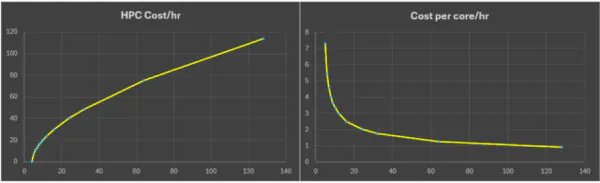
The real value of HPC lies in simulation scaling.
If a simulation completes significantly faster when more compute resources are added, the reduction in runtime can offset the higher hourly credit consumption.
In practical terms:
The balance between these factors determines whether a simulation becomes more or less expensive overall.
For well-scaled models, the reduction in solve time can completely offset the increased hourly licence usage.
To demonstrate this, we tested a relatively large CFD model using multiple processor counts.
Rather than running to full convergence, we measured the time required to complete 1,000 solver iterations and then calculated the associated Elastic credit consumption.
The results demonstrated two important trends:
Simulation Time Reduced Significantly
As additional cores were added, the solve time dropped consistently.
This behaviour is common in large CFD simulations, which often parallelise extremely well across multiple processors.
Total Elastic Credit Consumption Remained Stable
Despite higher hourly HPC usage, the faster solve times compensated for the increased consumption rate.
For this particular model:
The largest benefit was observed up to approximately 64 cores, after which performance gains began to level off.
This phenomenon, known as diminishing returns, is common in parallel computing and should always be considered when selecting core counts.
While CFD models often benefit substantially from large processor counts, structural simulations can behave differently.
For Ansys Mechanical analyses:
As a general guideline:
The optimal core count depends on model size, solver type, contact conditions, and available memory.
Many organisations do not have access to a dedicated 128-core workstation or on-premises HPC cluster.
Cloud computing provides an alternative approach.
Platforms such as Rescale offer pre-configured environments for Ansys simulations, enabling engineering teams to access large-scale computing resources on demand without investing in additional hardware.
When reviewing cloud infrastructure costs, even large simulations often prove surprisingly affordable.
For the test case examined, running on a 128-core cloud machine would cost less than $30 USD for the complete simulation.
This highlights an important point:
The licensing cost is often not the primary barrier to HPC adoption. In many cases, organisations can achieve significantly faster results for only a modest increase in total project costs.
The assumption that more HPC cores automatically mean higher simulation costs is often incorrect.
For well-scaled simulations:
CFD simulations, in particular, can deliver excellent returns from increased processor counts, while Mechanical analyses require a more careful assessment of scaling efficiency.
The most effective approach is to evaluate both runtime and total credit consumption together, rather than focusing solely on hourly licence cost.
At EDRMedeso, we help engineering teams optimise their simulation environments, licensing strategies, and HPC infrastructure to maximise productivity and minimise total project time.
Whether you’re looking to improve CFD throughput, evaluate cloud HPC options, or make better use of your Ansys Elastic Licensing investment, our specialists can help identify the most efficient approach for your workflows.