Structural Design Optimization with ANSYS Mechanical: A Practical Guide to Topology and Shape Optimization

Modern engineering teams are under constant pressure to create products that are lighter, stronger, more efficient, and faster to develop. Traditional design methods often rely on repeated cycles of CAD modeling, simulation, testing, and redesign. While effective, this approach can be time-consuming and may overlook innovative solutions hidden within a design space.
This is where structural design optimization becomes a powerful tool. Rather than creating a geometry first and verifying performance afterward, engineers can define performance targets and allow optimization algorithms to identify the most effective design. Using tools such as Ansys Mechanical, organizations can automatically explore thousands of design possibilities while balancing structural performance, manufacturing requirements, and product constraints.
Whether the objective is to reduce weight, increase stiffness, improve fatigue life, or discover entirely new structural concepts, optimization enables a more intelligent and data-driven engineering workflow.
In this blog, we’ll explore the key optimization methods available in Ansys Mechanical, including topology optimization, shape optimization, and parametric design approaches, as well as practical examples showing how these techniques can improve real-world engineering designs.
Structural design optimization is the process of automatically improving a component or assembly to achieve a specific engineering objective while satisfying defined constraints.
Typical objectives include reducing mass, lowering stress levels, increasing stiffness, improving fatigue performance, enhancing natural frequencies and minimizing material usage
At the same time, engineers can impose constraints such as maximum allowable stress, displacement limits, manufacturing requirements, material restrictions and geometric boundaries
By combining optimization algorithms with finite element analysis (FEA), engineers can systematically identify high-performing designs that meet all specified requirements.
Traditional engineering workflows often follow a familiar pattern: While effective, this process depends heavily on engineering intuition and can become time-consuming when multiple design variables are involved.
Optimization reverses the process.
Instead of creating a design first and testing it afterward, engineers define objectives and constraints upfront, then allow the software to identify the most effective geometry within those boundaries.
This approach delivers value in three key areas:
Optimization can be used to enhance important design metrics while maintaining critical requirements.
Common objectives include minimizing mass, reducing stress concentrations, increasing stiffness, improving fatigue performance, or maybe enhancing vibrational characteristics.
Rather than focusing on a single performance metric, optimization allows designers to pursue improvements while simultaneously respecting constraints such as allowable stress, displacement limits, or manufacturing requirements.
One of the most powerful applications of optimization occurs during early-stage design.
Topology optimization, in particular, can reveal load paths and structural concepts that may not be obvious when working from traditional design assumptions. By exploring how material should be distributed within a defined design space, engineers can discover entirely new structural arrangements before investing significant effort in detailed CAD development.
Engineering is often an exercise in compromise.
Lower mass may reduce stiffness. Increased stiffness may increase manufacturing costs. Improved vibration performance may require additional material.
Optimization provides a framework for evaluating these competing objectives and identifying designs that achieve the best overall balance.
Every optimization problem starts with two basic ingredients:
The objective defines what the engineer wants to achieve. This could be something like minimizing mass or maximizing stiffness.
Constraints define what the design must satisfy. These may include:
Without constraints, finding the optimum solution is often straightforward. In reality, engineering problems are rarely unconstrained.
As additional requirements are introduced, the search for the optimum becomes more challenging. The resulting design may not achieve the absolute best value for the objective, but it will achieve the best value while still satisfying all specified requirements.
This distinction is important. Optimization is not about finding the perfect design. It is about finding the best feasible design.
Most optimization workflows can be grouped into two categories: parametric optimization and field-based optimization.
Parametric Optimization
In parametric optimization, the engineer decides what aspects of the design can change.
These design variables might include:
The optimization process evaluates combinations of these parameters to determine which produces the best performance.
A classic example is a load-bearing hook. If the stress levels are comfortably below the material yield strength, the engineer may wish to reduce mass. Variables such as thickness, curvature, and profile dimensions can be adjusted automatically until the lightest acceptable design is found.
Typically, parametric optimization problems involve anywhere from a few design variables to several dozen.
Field-Based Optimization
Field-based optimization takes a very different approach.
Rather than adjusting a handful of predefined parameters, the software determines where changes should occur throughout the structure.
Examples include:
Instead of tens of variables, these methods may involve hundreds of thousands or even millions of design variables.
The question shifts from:
“Which dimension should change?”
to:
“Where should material exist?” or “How should this surface evolve?”
Because of this freedom, field-based methods are particularly valuable during conceptual design phases.
Topology optimization is often considered the most transformative optimization technique available today.
Rather than starting with a finished design, engineers begin with a design space: a volume within which material is allowed to exist.
Loads and supports are applied, and every finite element receives a design variable representing pseudo-density.
Elements can gradually evolve toward dense material and void space.
The optimization process continuously redistributes material while evaluating structural performance.
For example, an engineer may specify maximize stiffness and/or retain only 20% of the original mass.
The solver then identifies which regions carry load efficiently and which contribute little to overall performance.
The result is often a highly efficient structure featuring organic-looking struts, ribs, and load paths that would be difficult to conceive manually.
While topology optimization is ideal for discovering concepts, shape optimization is better suited to improving an existing design.
Instead of removing or adding material throughout a design space, shape optimization adjusts surface geometry by moving mesh nodes.
Topology remains unchanged:
This makes shape optimization especially useful when:
Because the structure remains recognizable throughout the process, translating optimization results back into production-ready CAD is often significantly easier.
Although different optimization methods pursue different goals, the underlying process generally follows the same iterative loop.
Define the Design Domain
The engineer identifies what is allowed to change and what must remain fixed.
Solve the Finite Element Model
Loads, supports, contacts, and constraints are evaluated using standard simulation techniques.
Calculate Sensitivities
The software determines how every design variable affects the objective and constraint functions.
This sensitivity information enables efficient updates across enormous numbers of variables simultaneously.
Update the Design
Material distribution, surface geometry, or other design variables are modified.
Check Convergence
The solver evaluates whether the objective and constraints have stabilized.
If not, the loop repeats.
Validate the Result
Once convergence is achieved, the optimized geometry is recreated as high-quality CAD and verified through additional analysis.
One of the historical criticisms of optimization has been that the resulting geometries often looked impressive but were difficult or impossible to manufacture.
Recent developments have dramatically improved this situation.
Manufacturing constraints can now be incorporated directly into the optimization process.
Examples include:
Casting Constraints: The optimizer can generate designs that can be removed from molds without undercuts, making them suitable for casting processes.
Extrusion Constraints: Uniform cross-sections can be enforced across selected directions, making designs suitable for extrusion or flame-cut manufacturing.
Additive Manufacturing Constraints: Requirements such as overhang control and build-direction considerations can be incorporated.
Symmetry and Pattern Constraints: Repeating features and symmetric geometries can be preserved where required.
Milling Constraints: More recent developments also allow optimization for subtractive manufacturing processes.
By including manufacturing considerations from the beginning, optimization can move beyond generating theoretically ideal structures and instead produce solutions that are practical to manufacture.
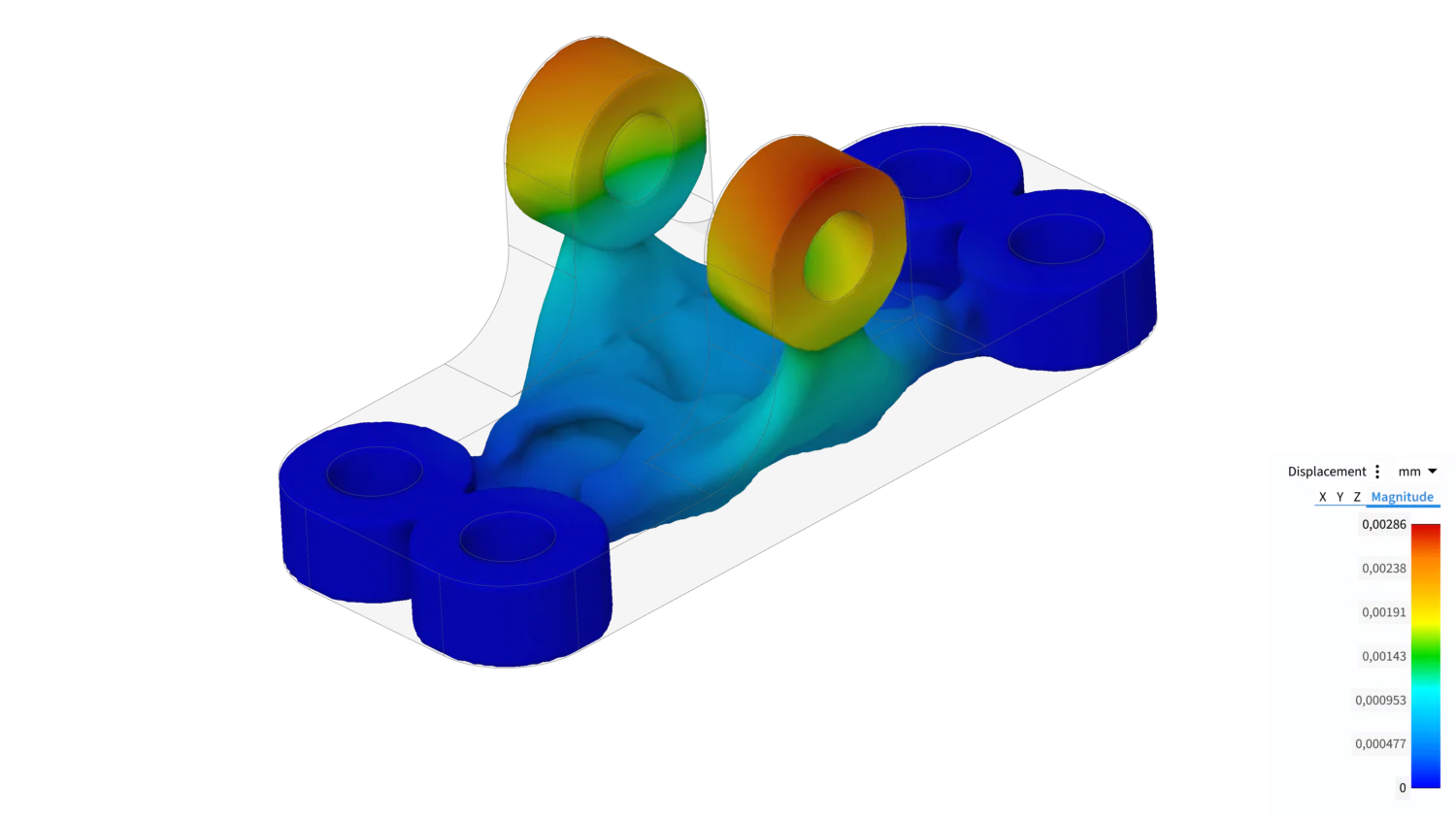
A useful example comes from the optimization of a lifting point used for handling large industrial components, including wind turbine parts weighing hundreds of tonnes.
The existing design consists of welded steel plates developed from earlier topology optimization work. While structurally effective, it still contains local stress concentrations and fatigue concerns.
The objective is simple:
Setting Up the Shape Optimization
Let’s say the model includes:
and we want to evaluate two critical load cases: fatigue loading and ultimate loading.
The optimization focuses on the upper plate while excluding regions where loads and contacts are applied.
Manufacturing constraints are introduced through an extrusion requirement to preserve a geometry suitable for laser cutting and fabrication.
The Results
After optimization, relatively subtle geometric changes emerged. To the naked eye, the design looks largely unchanged. However, small adjustments to surface contours redistributed load more effectively and reduced stress concentrations.
This highlights an important principle of shape optimization: major performance gains do not always require major geometric changes. Even modest shape adjustments can significantly improve fatigue life and reduce local stress peaks.
Once the optimization is completed, the deformed mesh can be exported and reconstructed into CAD using modern geometry reconstruction tools. This provided a clean, manufacturable model suitable for final validation and production.
A common concern among engineers is what happens after optimization.
Many optimization methods generate mesh-based geometries rather than traditional CAD models.
Modern workflows address this challenge through geometry reconstruction techniques.
An optimized mesh can be:
This workflow makes it possible to move from an optimization result to a fully editable engineering model suitable for detailed design, documentation, and manufacturing.
Selecting the appropriate optimization method depends largely on design maturity.
A practical workflow often looks like this:
Concept Stage
Use topology optimization to explore load paths and generate structural concepts.
Design Development
Use shape optimization to refine stresses, stiffness, and fatigue performance.
Detailed Engineering
Use parametric optimization to fine-tune dimensions, materials, and manufacturing tolerances.
Each method plays a distinct role, and the greatest value often comes from combining them as part of a broader design process.
Structural design optimization is transforming the way engineers develop products. By combining advanced simulation with automated optimization algorithms, tools like Ansys Mechanical allow engineering teams to move beyond traditional trial-and-error design methods and make decisions based on data-driven performance outcomes.
From early-stage topology optimization and concept generation to detailed shape optimization and manufacturing-focused refinement, modern optimization workflows help create lighter, stronger, and more efficient products. As manufacturing-aware constraints continue to evolve, engineers can increasingly generate designs that are not only high performing but also practical to produce.
For organizations seeking to accelerate innovation, reduce material consumption, and improve product performance, structural design optimization is rapidly becoming an essential part of the engineering toolkit.
Find out more about Ansys Mechanical
Watch our on-demand webinar, ‘Structural Design Optimization with Ansys Mechanical’