The Power of Training: Getting the Full Value from Your Simulation Software


Simulation software has become one of the most powerful tools in modern product development. It helps engineering teams explore more ideas, reduce physical prototyping, and bring better products to market faster. But the software alone doesn’t deliver those results. The people using it do.
At EDRMedeso, we see every day how structured training turns simulation tools from an expensive license into a real competitive advantage. Well-trained engineers work faster, make fewer errors, and use the full range of capabilities they’ve already paid for, which is exactly how companies maximize their return on investment.
Training is the bridge between potential and performance. Simulation involves complex decisions at every step, from building the model and setting up the analysis to interpreting the results with confidence. Each of those steps depends on skilled engineers.
The tools themselves are also changing quickly. GPU-accelerated solvers have cut run times from days to hours. Cloud and high-performance computing put large models within reach of teams of any size. AI and machine learning are being built directly into workflows, and digital twins are connecting simulation with real-world operating data. With Ansys now part of Synopsys, simulation and electronic design are also moving closer together.
Every one of these advances brings new possibilities, along with new complexity. Without the right training, teams risk using next-generation tools in last-generation ways.
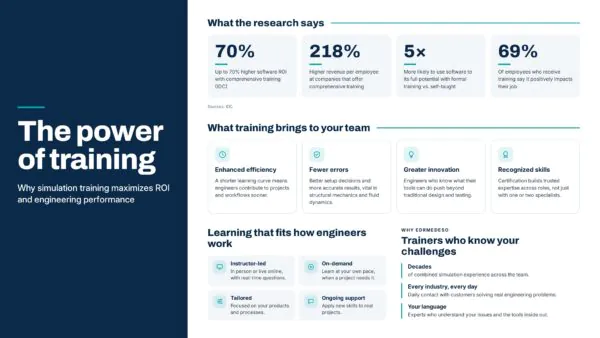
The link between training and software value is well documented. According to IDC, comprehensive training can increase the return on investment for software by up to 70%, by speeding up adoption and helping users get more out of the tools.
The benefits reach beyond the software itself. Companies that offer comprehensive training have been found to achieve 218% higher revenue per employee than those that don’t. Employees who receive formal training are also five times more likely to use software to its full potential than self-taught users. And 69% of employees who receive training say it has a positive impact on their job.
The message is clear: structured training, covering everything from core functionality to advanced features, pays off.
Enhanced efficiency. Training shortens the learning curve, so engineers can contribute to projects and workflows sooner and spend less time working around unfamiliar features.
Fewer errors. Engineers who understand both the physics and the software make better setup decisions, which leads to more accurate results. This is vital in fields where precision is critical, such as structural mechanics and fluid dynamics.
Greater innovation. When engineers know what their tools can really do, they can push beyond traditional design and testing. Good training goes further than navigating menus. It covers what to consider when analyzing real components and products, so teams can optimize designs with confidence.
Recognized skills. Certification gives engineers a clear measure of their capability and helps organizations build trusted expertise across roles, rather than relying on one or two specialists.
The most effective training combines several formats. Instructor-led courses, in person or live online, build strong foundations and allow real-time questions. On-demand learning lets engineers build or refresh skills at their own pace, right when a project needs them. Tailored training focused on your products and processes makes learning immediately relevant. And ongoing support helps teams apply new skills to real projects, which is where learning really sticks.
As tools evolve with each release, continuous learning keeps your team current rather than falling behind.
Our trainers bring hundreds of years of combined experience. They work with customers across a wide range of industries every day, so they know the problems engineers need to solve and how to help solve them. They speak your language, understand your challenges, and know engineering simulation tools inside out.
Adopting simulation software is a strategic move for any company that wants to stay competitive, but its full value is only realized when users are capable and confident. Investing in training improves efficiency and innovation and builds a more skilled, motivated workforce.
As simulation technology keeps evolving, one thing stays the same: training isn’t a one-time cost. It’s a continuous investment in the future of your engineering team.
Ready to get more from your simulation software? Explore EDRMedeso’s training courses or contact us to find the right path for your team.