Why simulate photonics: A practical guide for engineers


Photonics simulation enables engineers to predict how light behaves in complex optical systems before physical prototypes are built. From photonic integrated circuits (PICs) to AR/VR optics and quantum technologies, simulation is now essential for designing high-performance photonic systems.
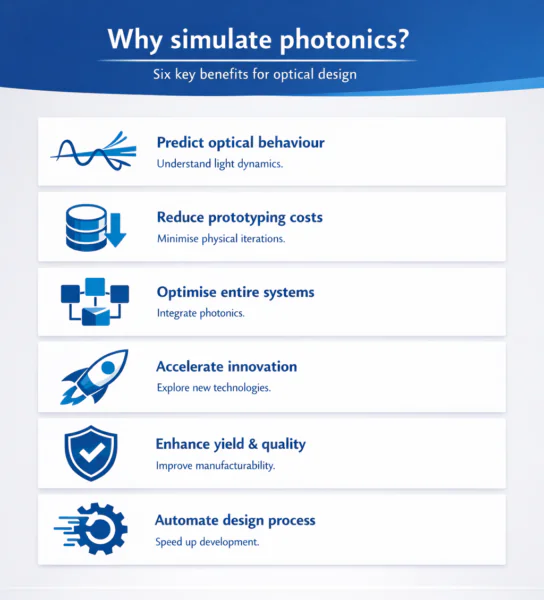
But why is photonics simulation so important? In this guide, we explore six key benefits that help engineers reduce costs, accelerate innovation and improve design accuracy.
Photonics operates in a wave-optics domain, where effects such as interference, diffraction, phase, and coupling directly impact system performance.
Simulation makes it possible to understand how light propagates and interacts with materials long before anything is fabricated. This is especially important at the nanoscale, where small design changes can lead to large performance differences.
With Ansys Lumerical, engineers can model light–matter interaction using advanced numerical methods to enable accurate simulation of complex phenomena across a wide range of photonics applications.
Fabrication in photonics is often both expensive and time-consuming, particularly when working with nanostructures, metasurfaces, or photonic integrated circuits.
Simulation helps identify performance issues early in the design process, including optical losses, coupling inefficiencies, crosstalk, and dispersion. By resolving these challenges before fabrication, engineers can significantly reduce the number of physical iterations.
The result is a faster design cycle, lower development costs, and a shorter path from concept to production.
Modern photonics design rarely happens in isolation. Optical components must work together with electronics, packaging, and mechanical environments to achieve the desired system performance.
Simulation enables engineers to take a system-level approach, combining component design with broader system considerations. For example, designs created in Lumerical can be transferred into tools like Zemax OpticStudio or Speos for further analysis and validation.
This connected workflow makes it possible to co-design photonic devices within their full application context, helping ensure performance in real-world systems.
Many of today’s most exciting photonics applications simply would not be feasible without simulation. This includes areas such as:
Ansys Lumerical supports a broad range of these use cases, including CMOS image sensors, liquid crystals, plasmonics, and metamaterials. This gives engineers the tools they need to explore new design spaces, validate concepts early, and push innovation forward.
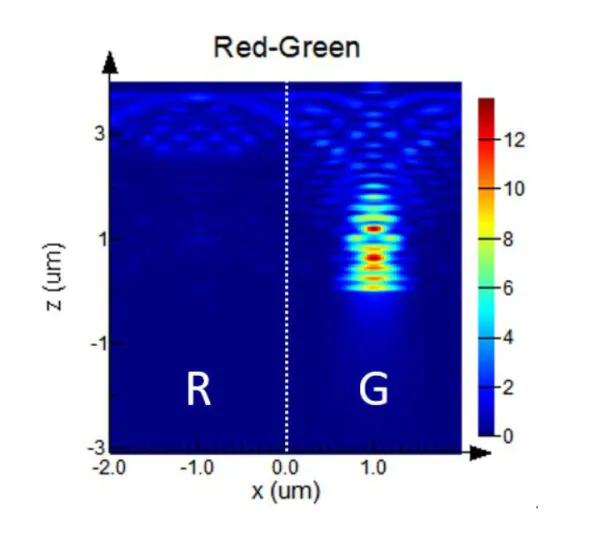
Simulated near field of green light injected on a CMOS device. The light is selectively transmitted through the green filter and eventually dissipated by absorption in the underlying silicon layer.
Photonic systems must operate reliably across a wide range of conditions, including wavelength shifts, temperature variations, and environmental changes. Simulation enables engineers to evaluate performance early, reducing the need for extensive physical testing and increasing confidence in the final design.
Simulation allows engineers to run sensitivity and tolerance analyses early, enabling more robust designs. This improves yield and supports the transition from prototypes to scalable, manufacturable photonic products.
Photonics design often involves exploring many parameters and configurations. Without simulation, this process would be slow and resource-intensive.
With Ansys Lumerical, engineers can automate simulations using Python through PyLumerical, enabling efficient parametric sweeps and design exploration. Combined with HPC, GPU acceleration, and cloud-based computing, this allows teams to significantly reduce simulation times and iterate faster.
This flexibility supports a more agile design process and enables better optimization.
Ansys Optics, with Lumerical at its core, provides a comprehensive platform for photonics simulation – covering everything from device-level physics to full system analysis.
Key capabilities include:
This connected environment allows engineers to move efficiently from component design to system validation, all within a unified workflow.
Want to learn more about simulating photonics with Ansys Lumerical? Did you know that you can book a demo of Ansys Optics tools and that we have 2-weeks free trials? If you would like to more, visit our Optics & Photonics page.
Join our upcoming live webinar on June 4th
What is photonics simulation?
Photonics simulation is the use of numerical modelling to predict how light interacts with materials and optical structures in a virtual environment.