Why Your Next Electronics Prototype Should Not Be Your First Test

Most teams accept multiple prototype iterations as normal.
A board fails EMC testing. A signal integrity issue appears. Something unexpected shows up in the lab.
So you fix it. Build again. Test again.
But every iteration has a cost:
This is not just engineering inefficiency. It is a business bottleneck.
Not because engineers are doing something wrong. Because the products have changed. Higher data rates, more complex layouts, stricter EMC requirements, tighter timelines. And far less margin for error.
In the past, engineers relied on experience and design rules. And that worked.
But today:
This means one thing: you can no longer rely only on experience and testing.
Let’s be direct. Finding problems during testing is expensive. Finding them after certification failure is even worse.
At that stage the design is already fixed in hardware. More often than not, the root cause is often unclear. Multiple variables are interacting and any chagnes are costly (and slow!)
You are no longer optimizing. You are reacting.
We made a conservative ROI scenario about this, which you can read here.
Simulation does not replace testing. It changes when you discover problems.
Instead of finding issues after the prototype, you identify them during design.
That shift has a direct impact:
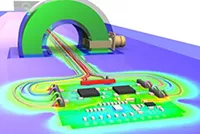
Simulation allows engineers to test ‘what-if’ scenarios, visualize fields and coupling, evaluate signal adn power integrity, and assess EMC behavior early. All the things that are difficult – or impossible – to see in the lab!
Without simulation, many design decisions are based on experience, assumption or rule of thumb strategies.
With simulation, those decisions are based on physics, measurable behavior and validated models.
This is especially important in modern designs where geometry matters as much as frequency, where small layout changes can have large knock-on effects and where interactions are not always intuitive.
A common concern is complexity.
Teams think simulation means more tools, or longer setup and inevitably slower processes.
In reality, the opposite is true when done correctly.
Modern workflows use fast PCB level simulation for early iterations with focused 3D simulation only where needed. There is also the option to combine speed and accuracy by way of a more hybrid approach. For example, SIWave for faster signal and power integrity analysis can be combined with HFSS for detailed 3D structures like vias, connectors and EMC sensitive areas. This approach avoids over-modeling while still capturing critical behavior.
The biggest benefit of simulation is not accuracy. It is decision speed.
When engineers can evaluate designs before building hardware decisions are made faster and fewer unknowns remain, with the result being teams move forward with confidence and purpose.
This directly impacts: time to market, development costs and product quality.
Choosing not to adopt simulation is still a decision. It means continuing to rely on late-stage testing, accepting unpredictable iterations and spending time you don’t have on debugging instead of designing. Also include taking higher risks before certification and it becomes clear that something has to change.
Meanwhile, other teams are already simulating early, reducing iteration cycles and improving product reliability and predictability. Over time, that gap becomes a competitive disadvantage.
You do not need to change everything at once. A practical approach is simple: Start with one real design challenge. It is knowing where to begin.
At EDRMedeso, we help companies identify where simulation brings immediate value. We define a practical starting point, avoiding any unnecessary complexity. Once there is a good understanding of your processes we help you implement the right Ansys tools, supporting teams in real development projects.
The goal is simple.
Reduce risk. Increase speed. Improve outcomes.
Discuss your current challenges with our experts
Get in touch today and take the first step toward simulation driven development.