Building Advanced CFD Capability for Hydrostatic Bearing Design

R&D Test Systems is a leading engineering company specialising in the design and delivery of large-scale test benches for industries such as wind energy, aerospace, and heavy industry. With a team of around 100 engineers and deep expertise spanning mechanical design, automation, and validation, the company is known for delivering complex turnkey solutions.
As systems in these industries become more complex, the need to accurately simulate real-world behaviour – particularly fluid-structure interactions – has become increasingly critical. This case study explores how EDRMedeso supported R&D Test Systems in developing advanced CFD (Computational Fluid Dynamics) capabilities and integrating them with structural simulation to analyse hydrostatic bearing systems.
Hydrostatic bearings offer a compelling alternative to traditional roller or hydrodynamic bearings in high-load applications. These systems rely on fluid pressure to maintain a separation between surfaces, enabling precise load handling and reduced wear.
R&D Test Systems is exploring hydrostatic bearings as a potential technology for applications such as wind turbines, validation test rigs and large-scale industrial systems.
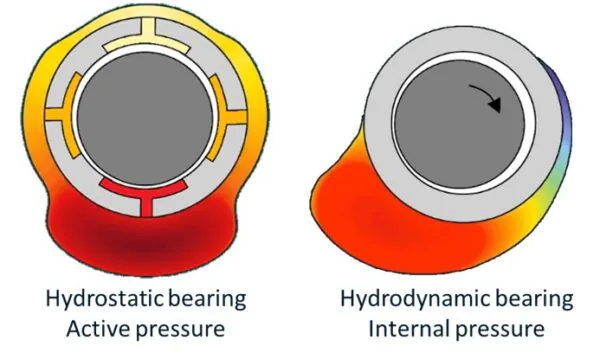
However, designing these systems presents a significant challenge.
Unlike simpler mechanical components, hydrostatic bearings are governed by tightly coupled physical phenomena:
In particular, the performance of the bearing depends on how these variables interact under real operating conditions. Even small structural deformations can significantly impact fluid film behaviour, especially where tolerances are tight.
To move forward, R&D Test Systems needed:
To address these challenges, R&D Test Systems partnered with EDRMedeso through a structured adoption and enablement programme focused on long-term capability building.
Rather than treating simulation as a service, the approach centred on embedding knowledge and tools within the customer organisation. This included:
Crucially, the programme enabled intensive collaboration and continuous skills development, ensuring that knowledge transfer was practical and immediately applicable.
This approach provided high-value on-site advisory support that helped accelerate engineers’ understanding of fluid mechanical fundamentals. This also functioned as internal training, reducing reliance on external services and enabled knowledge retention and reuse across projects.
This foundation allowed R&D Test Systems to transition from limited CFD experience to confident application in real engineering challenges.
The development of CFD capability followed a structured learning path, combining theory, practical application, and iterative refinement.
Step 1: Building Fundamental Understanding
The journey began with core fluid mechanics principles, including key theoretical concepts, pressure-temperature-density coupling and basic flow behaviour in simplified systems. This ensured that engineers understood not just how to run simulations, but how to interpret results and make informed engineering decisions.
Step 2: Applying CFD to Simplified Models
Once the fundamentals were established, the next step was to introduce CFD tools through simplified geometries.
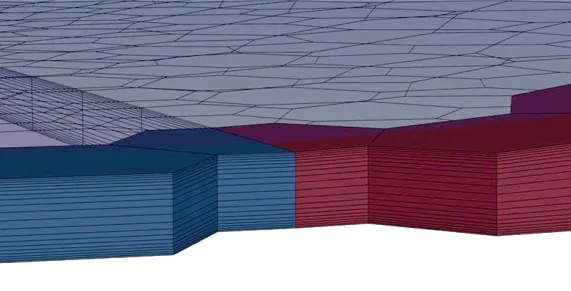
This phase focused on isothermal, incompressible flow analysis, developing meshing capabilities in Ansys Fluent and understanding solver setup and boundary conditions. By working with simplified models, the team could focus on building confidence without being overwhelmed by full system complexity.
Step 3: Scaling to Real Engineering Problems
With core skills in place, the team progressed to more realistic simulations of hydrostatic bearing systems.
At this stage, the key challenge was capturing the interaction between multiple physical effects, including:
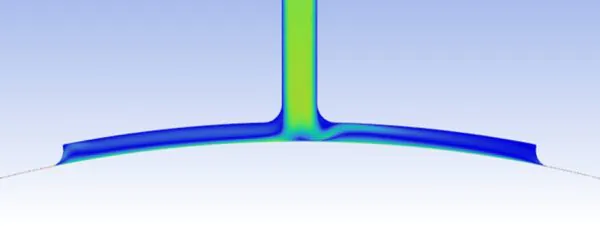
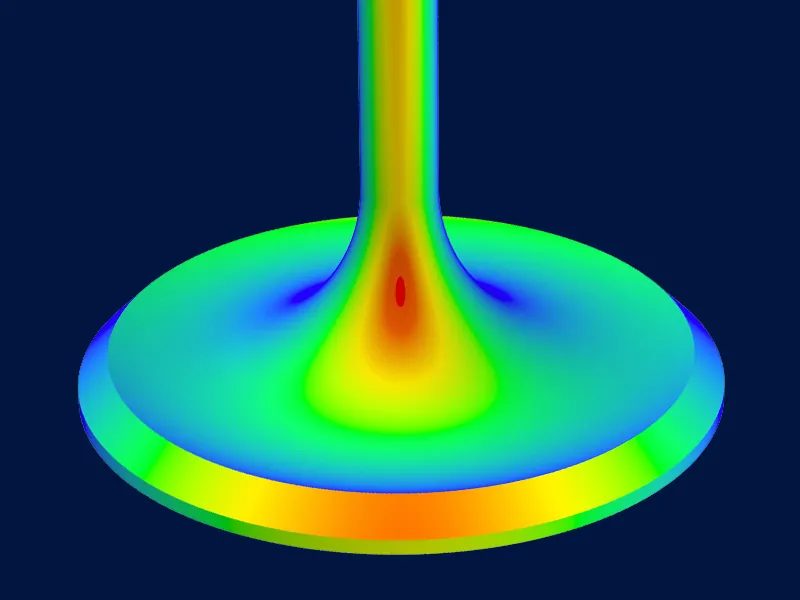
The core breakthrough in this project was the application of coupled simulation techniques, integrating CFD with structural analysis.
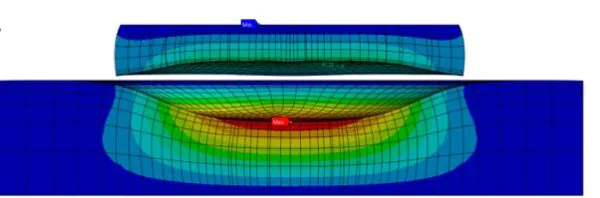
Using Ansys System Coupling, the team was able to link fluid and structural models and transfer variables such as pressure and deformation between domains, as well as capture the bidirectional interaction between fluid flow and structure.
Key material and system interactions including pressure, temperature, density, viscosity, conductivity, heat capacity and finally structural displacement.
This approach was particularly important due to the tight tolerances in hydrostatic bearing design. Even small structural deformations can change the fluid gap, influencing pressure distribution and overall system performance.
By incorporating these effects, the simulations provided a far more accurate representation of real-world behaviour compared to isolated analyses.
By combining structured learning with real-world application, R&D Test Systems achieved both immediate and long-term benefits.
1. Improved Design Understanding
The coupled simulations enabled the team to gain deeper insight into key performance factors, including required pressure levels, flow characteristics, cooling requirements and load distribution. These insights were critical for designing reliable and efficient hydrostatic bearing systems.
2. Strong Internal Capability
One of the most significant outcomes was the development of internal expertise. The team moved from limited CFD knowledge to a working, scalable simulation capability integrated into engineering workflows. This reduced the need for external analysis support and ensured that simulation could be applied across multiple projects.
3. Faster and More Informed Decision-Making
With simulation embedded into the design process, engineers could test concepts earlier, validate assumptions before physical testing and reduce design risk. This is particularly valuable in large-scale systems where physical testing is expensive and time-consuming.
EDRMedeso’s role in this transformation was not simply to provide software, but to enable R&D Systems to:
1. Capability Building Drives Long-Term Value: training and mentoring enabled R&D Test Systems to internalise simulation expertise, reducing reliance on external support.
2. Multi-Physics Simulation Is Essential for Complex Systems: coupling CFD and structural analysis provided a more accurate understanding of hydrostatic bearing behaviour.
3. Practical Application Accelerates Learning: working on real engineering problems ensured that knowledge transfer was relevant and immediately useful.
4. Simulation Enables Better Engineering Decisions
5. Improved insight into pressure, flow, and load conditions allowed for more confident design choices.
Through collaboration with EDRMedeso, R&D Test Systems has successfully developed the capability to analyse and design complex hydrostatic bearing systems using advanced simulation techniques cementing their status as the go-to partner and expert in heavy-duty test bench design.
By combining technical mentoring, structured learning, and multi-physics modelling, the company has strengthened its engineering processes and built a foundation for future innovation.
As engineering challenges continue to evolve, this learning approach focused on capability building and real-world application, provides a scalable model for like-minded organizations looking to unlock the full potential of simulation.
[With special thanks to Thomas Møller Christiansen, Senior Mechanical Specialist, R&D Test Systems, for his contribution here and at our Meet The Experts event in Vejle]