Using Ansys Simulation to Enable First‑Time‑Right High‑Speed PCB Design: How Etteplan helped push the limits of optoelectronic connectivity


As data volumes grow and connectivity demands accelerate, engineering teams are under increasing pressure to deliver designs that perform reliably at unprecedented speeds. In areas such as AI‑driven data centres and emerging computing technologies, even minor signal integrity issues can compromise entire systems. At these speeds, success depends on deep technical expertise and on having the right simulation tools in place.
This was the reality facing Phanofi, a Danish technology company focused on bridging the gap between photonics and electronics. Phanofi’s goal was ambitious: to design a printed circuit board (PCB) for an optoelectrical conversion chip capable of operating at up to 200 Gbit/s. Achieving this level of performance required absolute confidence in how high‑speed signals would behave across the board, long before any hardware was manufactured.
To meet this challenge, Phanofi partnered with Etteplan, drawing on Etteplan’s experience in high‑speed electronics design and electromagnetic simulation.
Central to Etteplan’s approach was the use of Ansys simulation technology, provided and supported through EDRMedeso, Etteplan’s simulation partner. Together, this combination enabled Phanofi to complete their design successfully on the first attempt, avoiding redesign cycles and accelerating their path to innovation.
Phanofi’s work sits at the cutting edge of data communication. Their technology focuses on enabling efficient interaction between photonics and electronics, a critical requirement as optical interconnects become increasingly important inside modern data centres.
At data rates approaching 200 Gbit/s, PCB design becomes extremely sensitive to electromagnetic effects. Issues such as signal loss, impedance discontinuities and crosstalk that might be manageable at lower speeds can quickly undermine performance. Traditional “design‑build‑test” approaches are no longer sufficient; by the time problems are discovered in hardware, costs and delays can escalate rapidly.
For Phanofi, the key requirement was confidence:
This made advanced electromagnetic simulation not optional, but essential.
Etteplan was brought into the project to provide expert guidance on high‑speed PCB design and verification. With extensive experience in electromagnetic simulation and signal integrity analysis, Etteplan was well placed to help manage the complexity of the design.
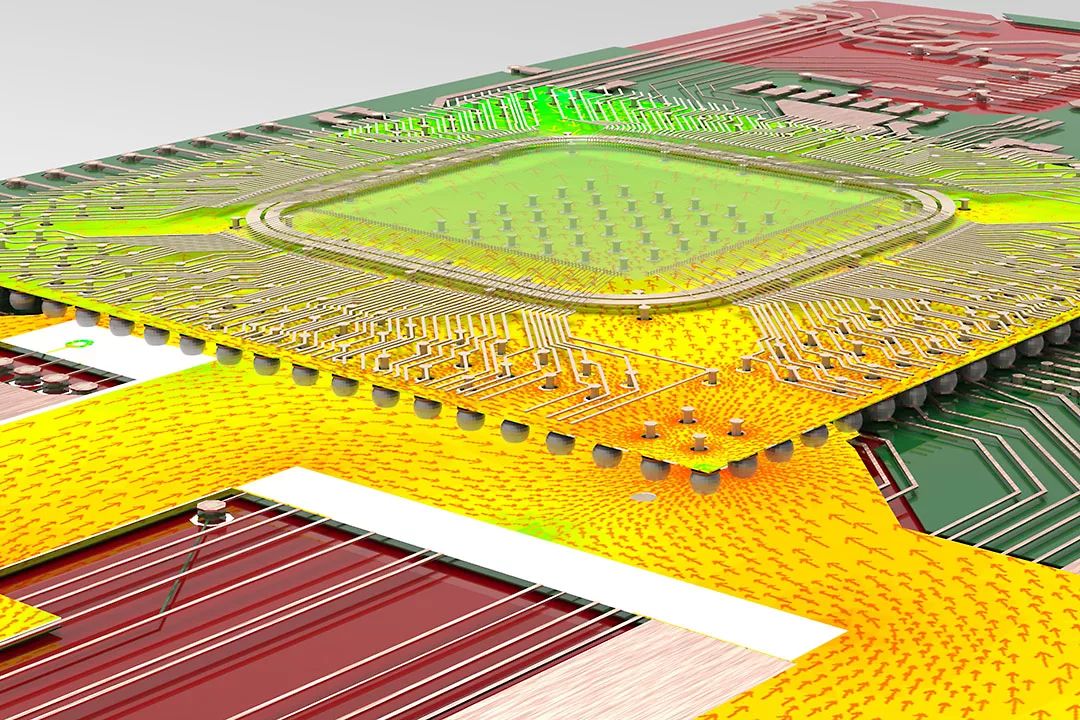
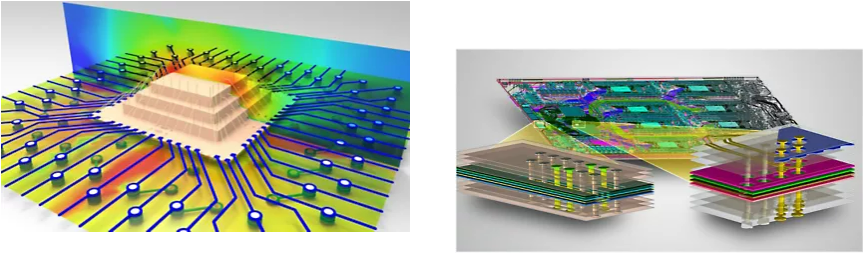
Rather than relying on simplified rules of thumb, Etteplan’s approach centred on 3D electromagnetic simulation using the Ansys electronic design environment. This enabled a detailed understanding of how high‑speed signals would propagate through the PCB, how electromagnetic fields would interact with physical structures and where potential risks might arise.
An important part of Etteplan’s delivery model is access to robust, industry‑proven simulation tools, backed by expert support. In this project, that capability was enabled through EDRMedeso, Etteplan’s simulation partner, who provides not only the software itself but also the technical expertise that ensures it can be used effectively in demanding real‑world projects.
At the performance levels Phanofi was targeting, simulation accuracy and reliability were critical. Ansys electromagnetic solvers are widely recognised for their ability to handle complex 3D field problems with the fidelity required at very high frequencies and data rates.
For Etteplan, working with Ansys software ensures:
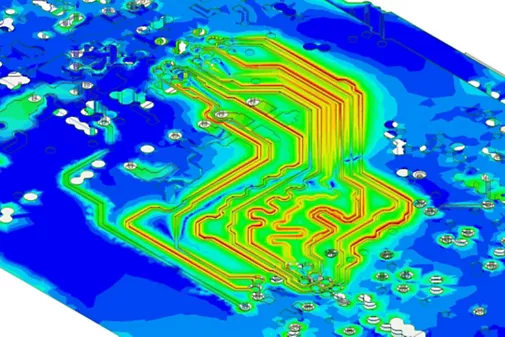
Using simulation, Etteplan’s specialists were able to analyse the electromagnetic effects of rapid signal transitions across the PCB in detail. This made it possible to:
Simulation effectively replaced the uncertainty of physical prototyping with data‑driven insight. Instead of iterating through multiple hardware revisions, design adjustments could be made in the virtual environment quickly, efficiently and without manufacturing risk.
For Phanofi, this meant gaining clear, actionable feedback early in the design process. Design decisions could be finalised with confidence, significantly reducing uncertainty and development time.
The most tangible outcome of the collaboration was that Phanofi completed their high‑speed PCB design successfully on the first attempt. This is a significant achievement at data rates of 200 Gbit/s, where redesigns are common and costly.
From an Etteplan perspective, this result highlights the value of combining:
For Phanofi, the benefits were clear:
Just as importantly, Phanofi gained confidence that their solution would work as intended, a critical factor when pushing technical boundaries.
One of the strengths of this project was the collaborative working model between Phanofi and Etteplan. Simulation was not treated as a black‑box verification step, but as an integral part of the design conversation.
Etteplan’s experts used Ansys simulation results to explain electromagnetic behaviour in a way that supported Phanofi’s own engineering decisions. This shared understanding helped streamline the design process and ensured that changes were guided by physics‑based insight rather than assumptions.
This approach reflects Etteplan’s broader philosophy: simulation is most powerful when it supports dialogue between specialists and customers, enabling better decisions rather than simply producing reports.
While this specific project focused on optoelectrical conversion for high‑speed data centres, the implications are broader. Technologies that merge photonics and electronics are also key to emerging fields such as advanced computing and quantum technologies, areas where signal behaviour is even more critical.
By using simulation, Etteplan is able to support customers working at the forefront of these developments. The tools and expertise used for Phanofi’s PCB design are equally applicable to a wide range of high‑performance electronic systems.
In this context, simulation becomes a strategic capability, helping companies innovate faster while controlling risk.
An important lesson from this collaboration is that advanced simulation does not need to be a permanent internal investment for every company. By working with Etteplan, and by extension with EDRMedeso, customers like Phanofi can access exactly the level of simulation capability they need, when they need it.
This scalable approach:
For Etteplan, EDRMedeso’s support ensures that the Ansys tools used in these projects remain fully supported, up‑to‑date and aligned with industry best practice.
The collaboration between Phanofi, Etteplan and EDRMedeso demonstrates how simulation can move from being a risk‑mitigation tool to a true innovation enabler.
By validating electromagnetic behaviour early, using Ansys simulation, Etteplan helped Phanofi achieve a complex design goal without costly iteration. This first‑time‑right outcome is not only efficient, but it also builds confidence, both technically and commercially.
For Etteplan, projects like this reinforce the value of investing in strong simulation partnerships. For Phanofi, they provide a pathway to deliver advanced connectivity solutions that meet the demands of tomorrow’s data infrastructure.