Data Driven Strategy


Engineering is undergoing fundamental transformation – not in tools or processes, but in the underlying principle by which products are created, validated and operated.
This paper describes one possible destination for these changes: a fully connected, data-driven engineering enterprise in which every decision is evidence-based, every product iteration builds on the last, and products continue to learn and improve throughout their operational lives.
It’s not simply a case of developing better products. It is one of transforming how engineering decisions are made. For decades, product development has relied on a sequential model built around documents, file-based information exchange and organisational silos. While successful in an earlier era, these approaches struggle to keep pace with the complexity and speed required by modern engineering operations.
Data replaces files as the primary asset. Leading organizations create connected engineering environments where requirements, architecture, simulation, manufacturing data and operational information remain linked throughout the entire lifecycle. In these environments, engineering decisions are informed by evidence rather than assumptions, validation occurs continuously rather than periodically, and products continue generating value long after deployment through operational feedback and digital twin technologies.
The organizations that successfully establish this connected engineering transformation will be positioned to innovate faster, improve product performance and build engineering capabilities that scale more effectively than traditional approaches. Engineering capability does not grow linearly with headcount and those that do not transform will find themselves at a structural competitive disadvantage.
Most engineering organizations have operated using processes that were developed when products were less connected, less software-intensive and significantly less complex than they are today; requirements captured in documents, designs created within specialist tools, testing taking place late in development, and operational experience often disconnected from future engineering decisions.
Although these approaches have enabled decades of innovation, they are increasingly strained by modern engineering realities.
The result is a model that is resource-intensive, slow to adapt, heavily dependent on individual experience, and structurally incapable of continuous improvement. The question is not whether this model needs to change – it is what replaces it.
The organizations achieving the greatest advances in engineering performance are not simply implementing new software tools. They are changing how engineering information is created, managed and used.
In a connected engineering enterprise, data is the foundational asset upon which all engineering activities are built.
Data replaces files as the primary asset. Leading organizations create connected engineering environments where requirements, architecture, simulation, manufacturing data and operational information remain linked throughout the entire lifecycle, as a single, connected digital thread.
Every transformation of that data is explicit and traceable. Every decision is supported by evidence rather than experience alone. The organization learns as a system, not just as a collection of individuals.
This shift to this future state delivers several strategic benefits:
This is not a single platform or a specific technology investment. It is a transformation in the architecture of engineering; the way information is created, stored, transformed, shared and consumed across the entire lifecycle.
The technology exists.
The question is how it is assembled and connected.
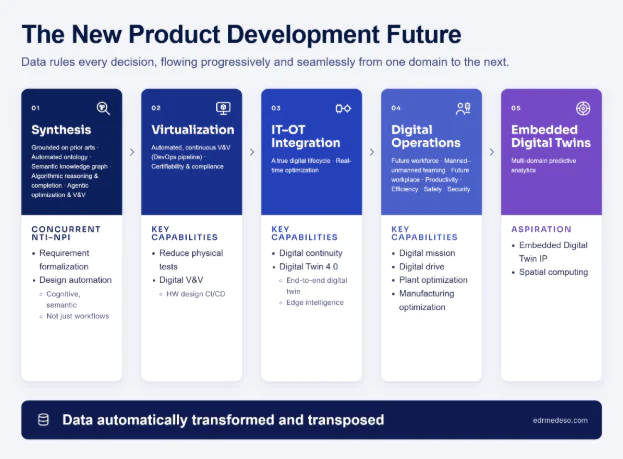
The transformation of engineering can be understood through five interconnected stages. Together, they describe a complete, continuous lifecycle – one that begins the moment a customer need is identified and continues for the entire operational life of the product. Each stage builds on the last and feeds into the next; together they constitute not a process but a system.
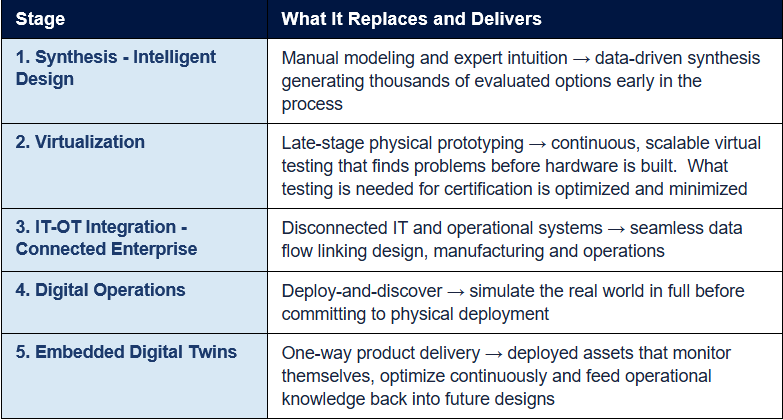
Every successful engineering process starts with understanding what needs to be built and why.
Historically, requirements have been captured in documents that require extensive manual interpretation before engineering work begins. In the future state, a connected engineering environment, requirements become structured, machine-readable information, that can be processed and built upon by automated systems.
Requirements are expressed in formal, semantic language – the concept of operations (CONOPS) capturing customer focus and engineering intent, where objectives can be represented in ways that support both human understanding and computational analysis.
From that foundation, automated systems can generate large numbers of design concepts and evaluate them against performance, cost, schedule and risk criteria simultaneously. The casting of the net wider in order to consider more options can, and usually allows for a better option to be identified and selected.
For business leaders, this approach fundamentally changes decision-making economics of the design phase in two important ways.
First, design no longer depends on the experience of a small group of experts constructing a single solution. Thousands of design possibilities can be explored and evaluated in the time it once took to develop one.
Second, early in the process, before any physical hardware exists the organization has quantitative evidence about the likely performance, cost and risk of different approaches.
Decisions that were once made on intuition and experience are made on data; earlier, with greater confidence, and at a fraction of the cost.
Over time, the knowledge captured in this process, the rules, the trade-offs, the performance data, accumulates as a corporate asset. Each new product benefits from everything the organization has learned on every previous one. The knowledge that once walked out of the door with experienced engineers is embedded in systems that and becomes a permanent organizational asset.
Physical testing has always been the final arbiter of engineering decisions. It is also one of the most expensive activities in any development programme and it is fundamentally too late in the process to materially affect the design: a physical prototype can only reveal a problem after it has been built, which is precisely when it is most costly to fix.
In modern virtual engineering environments, digital models capturing the hardware physical performance along with the software logical control models become the primary means of verification and validation. Simulation tools test a design across thousands of scenarios, conditions and edge cases in a fraction of the time required for physical testing. They can explore failure modes that would be impractical or dangerous to ree. And they can be reused, adapted and improved across multiple product generations.
This does not mean physical testing disappears. For certain categories of validation, especially regulatory certification, physical evidence will always be required. But the nature of physical testing changes: it becomes confirmation, not discovery. Problems are found and fixed in the simulation models long before the first prototype is built.
Validation also becomes continuous rather than staged. Just as software engineering has embraced automated continuous integration, development and deployment (CICD), engineering organizations of the future are increasingly moving toward continuous verification and validation. Design changes can be assessed as they occur, reducing the likelihood of costly surprises later in the lifecycle.
One of the most significant structural barriers in modern engineering organizations is the gap between digital engineering systems and manufacturing or operational systems. Engineering tools and enterprise IT systems operate in one domain; shop-floor manufacturing systems and operational technology operate in another. Data rarely flows between them without significant manual effort .
In the future state, a connected engineering enterprise removes many of these barriers by establishing a common digital thread across the organization. Engineering data becomes available to manufacturing systems. Production data informs engineering decisions. Operational information contributes to future product development in a timely and structured way. Information moves across organizational boundaries without being repeatedly recreated, transformed or manually reconciled. The entire enterprise shares a common digital backbone, the digital thread, connecting every stage from design intent to operational reality.
The practical consequences are significant:
Before a product is deployed, the organization of the future can execute its complete virtual prototype in realistic operational scenarios, simulating the actual conditions in which the product will be used, including environmental variability, interactions with other systems, degradation over time, and the full range of operational demands.
This capability fundamentally changes decision quality.
Rather than validating whether a product functions under controlled conditions, organizations can assess how it is likely to perform under realistic operational circumstances.
For regulated industries, this is particularly significant. Comprehensive simulation provides a powerful mechanism for demonstrating compliance and supporting certification activities through evidence-based engineering approaches.
For commercial organizations, it creates opportunities to optimize products around actual operating conditions, customer behaviours and real-world usage patterns.
The result is greater confidence at deployment and reduced exposure to costly post-deployment issues.
In the future engineering lifecycle, the relationship between an organization and its products does not end when those products are deployed. A digital twin creates a living connection between a deployed asset – be it a vehicle, a piece of industrial equipment, a defense system or an infrastructure installation – and its digital representation. Operational information continuously updates the digital model, enabling organizations to monitor performance, predict future behavior and improve decision-making throughout the asset lifecycle.
The digital twin turns every deployed product into a source of intelligence about performance, degradation, failure risk and operational patterns that feeds continuously back into the engineering organization.
This creates three strategic categories of capability that do not exist in the traditional model:
This transformation is ultimately about business performance. Although enabled by technology, its significance lies in the outcomes it creates for those organizations who adopt it and for their competitors who do not.
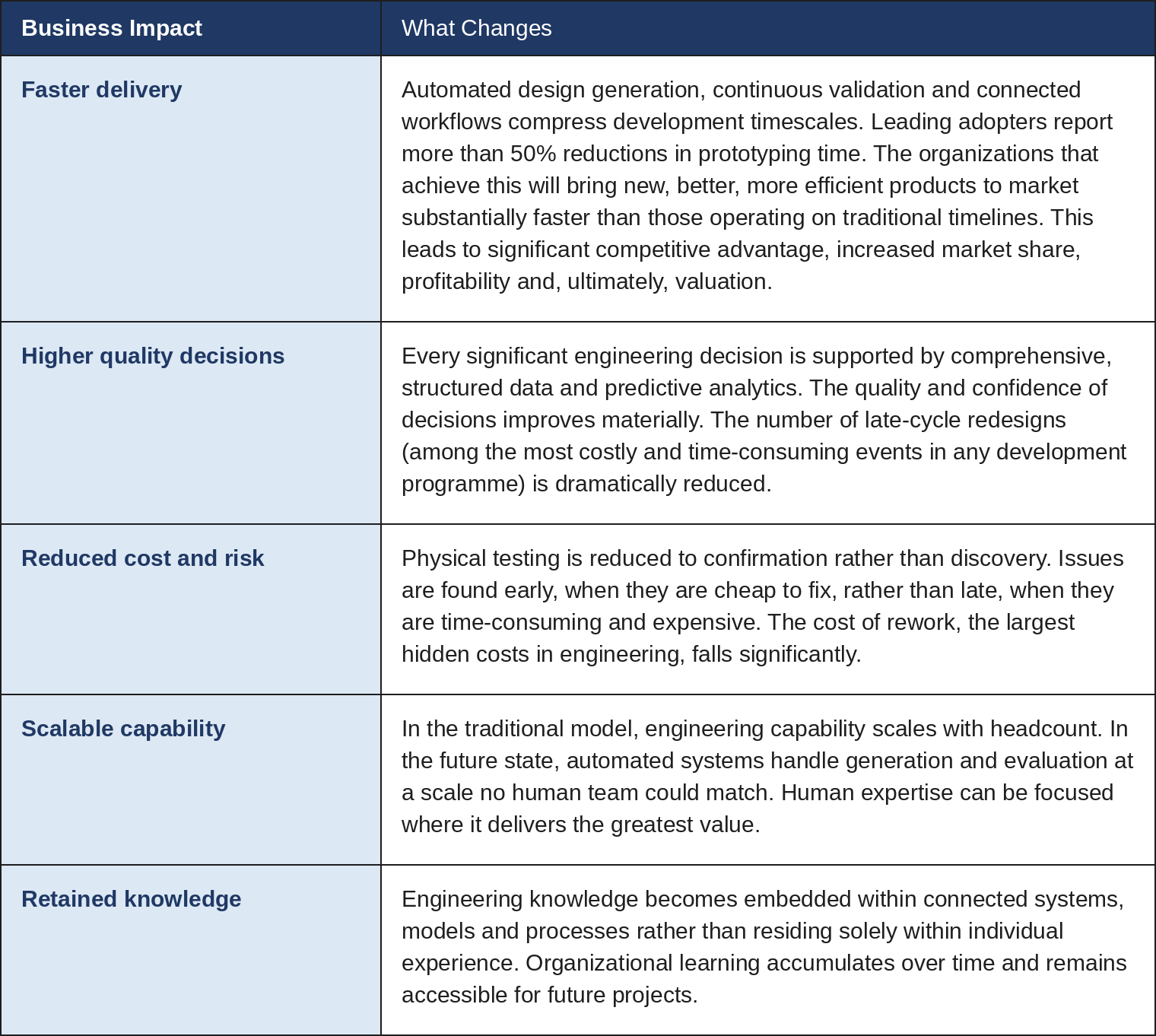
Throughout the lifecycle described in this paper, artificial intelligence is becoming an increasingly important component of modern engineering environments. However, its greatest value emerges when combined with trusted engineering data, validated models and established engineering expertise woven into every stage.
In design synthesis, AI systems generate and evaluate design options at a scale and speed that are simply impossible for human teams working through conventional methods. Where an engineering team might develop and assess a handful of design concepts over several months, AI-driven systems can explore thousands, evaluating each against multiple performance criteria simultaneously.
In virtualisation, AI-powered models learn to predict the results of complex simulations in milliseconds rather than hours, enabling exploration of design spaces that would otherwise be computationally impractical. This is not a replacement for rigorous simulation, it is a way of extending the reach of rigorous simulation to far more of the design space than was previously practical.
In digital operations, AI drives the pattern recognition and predictive analytics that make real-time monitoring and predictive maintenance possible at scale. AI also powers the optimization algorithms that allow operational systems to adapt continuously, adjusting behaviour in real time to maximise efficiency, reliability or safety.
The pace of development in this field is striking. From near-zero publications in 2016, peer-reviewed research on AI-driven engineering optimisation has grown to over 14,000 papers by 2025, with growth accelerating sharply in the last three years. The capabilities being demonstrated in research, real-time inverse design, AI-generated geometry, physics-informed modeling across multiple engineering domains, are moving from laboratories into engineering practice within the next three to five years.
The organizations achieving the greatest value are not replacing engineers with artificial intelligence. They are enabling engineers to focus more of their time on judgement, innovation, system thinking and the management of uncertainty.
Organizations that understand this trajectory and position themselves to benefit from it will have a significant structural advantage over those that treat AI as a peripheral addition to existing workflows.
The engineering organization described in this paper is not a distant aspiration or purely theoretical. Its constituent capabilities, System Architectural Models (SAM), Design Reference Missions (AGI STK) digital twins (TwinBuilder), AI-driven design synthesis, continuous virtual validation, IT-OT integration, agentic workflow orchestration, largely exist today or are being deployed by leading organizations. What is new is the convergence of these capabilities into a coherent, continuously connected lifecycle.
The organizations that achieve this transformation will operate with fundamentally different economics from those that do not. They will develop better products, faster. They will make decisions with greater confidence and lower risk. They will learn from every deployed product throughout its operational life (like Tesla), creating a self-improving system that compounds competitive advantage over time.
Three characteristics define the destination, the connected engineering enterprise::
The challenge facing engineering leaders is no longer whether these capabilities will become important.
The challenge is how quickly organizations can connect them, scale them and translate them into measurable business advantage.
Those that succeed will be positioned to innovate faster, reduce risk, retain knowledge and continuously improve product performance in an increasingly competitive and complex world.