Designing Cooler Electronics Faster: Why Thermal Simulation Can’t Be an Afterthought Anymore
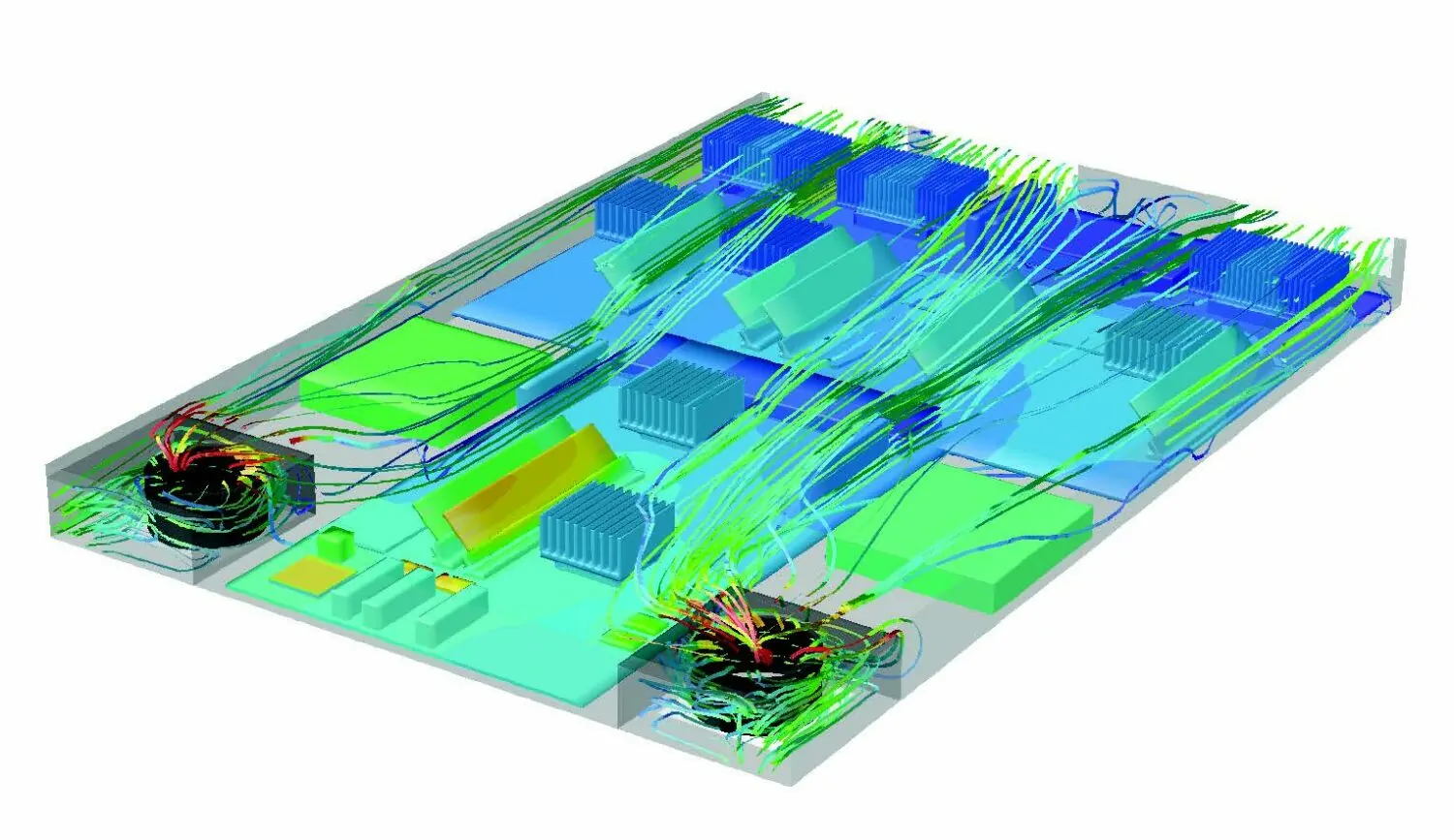

This blog explores how Ansys Icepak enables engineers to address this challenge through simulation‑driven electronics cooling workflows, connecting electrical, thermal, and system‑level design into a single, coherent process.
Key insights covered here include: why thermal integrity matters more than ever, how electronics cooling has become a multi‑physics problem, and how Icepak fits into a modern simulation workspace.
Electronic devices are getting smaller, more powerful, and more densely packed. All the while, expectations for reliability continue to rise.
That combination creates an uncomfortable challenge for engineers: more heat, less space, and less margin for failure. Whether you’re designing power electronics, PCBs, IC packages, or system‑level electronics, thermal behaviour is no longer something that can be “checked later”.
Traditionally, simulation has often been treated as a validation step, used near the end of development to confirm that a design meets its requirements before prototyping.
But this approach leaves too much value on the table.
Simulation‑driven design turns that model on its head. Instead of waiting until the design is nearly complete, simulation is used:
The result is faster development, fewer late‑stage surprises, and more robust, optimized products.
This approach is particularly important for electronics, where thermal behavior directly affects:
The trend is undeniable.
Modern electronic systems are more compact, more powerful and more complex.
With higher power densities come higher losses, and therefore more heat. At the same time, shrinking form factors reduce airflow and limit available cooling strategies.
This creates a perfect storm: local hotspots are harder to predict, thermal margins shrink and failures become more likely.
At this point, electronics cooling is no longer just a thermal problem. It becomes a multi‑scale, multi‑physics challenge, spanning silicon and IC packages, PCBs and board assemblies and enclosures and full systems.
To handle this complexity, engineers need tools that reflect how electronics are actually designed.
Ansys Icepak is a CFD‑based thermal simulation tool specifically developed for electronics cooling and thermal integrity analysis.
Built on the pedigree of Ansys Fluent, Icepak retains the physics fidelity of general‑purpose CFD but wraps it in workflows and automation tailored to electronics engineers.
This makes Icepak both powerful and accessible, even for users who don’t want to spend their time tuning CFD meshes or solver parameters.
One of Icepak’s defining strengths is its ability to support multi‑scale modeling, often described as “from silicon to systems”.
Using a single tool, engineers can analyse:
This continuity is critical. Thermal issues rarely exist in isolation and decisions at one level often affect performance elsewhere in the system.
Icepak supports all major heat‑transfer modes:
It handles both steady‑state and transient thermal analysis, allowing engineers to evaluate peak temperatures as well as time‑dependent behaviour under real operating cycles.
Unlike generic CFD tools, Icepak is designed to work directly with:
This removes significant setup friction and ensures simulations reflect how electronics are actually built.
Icepak’s meshing workflow is intentionally high‑level. While Fluent offers full control for CFD specialists, Icepak focuses on automation, allowing electronics engineers to get reliable results without micromanaging mesh details.
This reduces setup time dramatically while maintaining accuracy for electronics applications.
Icepak includes extensive libraries for:
These can be rapidly applied and adjusted, making it easier to compare cooling strategies early in the design process.
Engineers can run parametric analyses and system‑level optimisations to evaluate trade‑offs between:
Icepak is fully integrated within Ansys Electronics Desktop (AEDT), alongside tools such as:
This integration enables seamless electro‑thermal workflows.
Depending on the application, engineers can choose:
This is essential when properties such as resistivity or conductivity vary significantly with temperature, common in power electronics and high‑current designs.
Thermal results from Icepak don’t stop at temperature plots.
Detailed thermal maps can be exported to:
This enables engineers to understand not just how hot a design gets but how thermal behaviour affects structural integrity and long‑term reliability.
Many teams now begin thermal exploration in Ansys Discovery using fast, interactive simulation to explore geometry changes and conceptual cooling strategies.
When higher fidelity is required, Discovery models can be transferred automatically into Icepak, where:
can be added.
This process allows engineers to move smoothly from conceptual exploration to detailed validation, without rebuilding models from scratch.
To support adoption, EDRMedeso offers dedicated Icepak training, covering:
The goal isn’t to make participants instant experts but to give confidence and understanding needed to integrate Icepak into real engineering workflows quickly.
Custom company‑specific training is also available, tailored to particular tools, applications, and design challenges.
Thermal behaviour is no longer a secondary consideration.
As electronics continue to evolve, cooling performance directly impacts product reliability, performance, and time‑to‑market. Teams that control thermal behaviour early—and across disciplines—gain a decisive advantage.
Ansys Icepak plays a central role in enabling this shift, turning electronics cooling from a late‑stage problem into an integrated part of design.
Watch our on-demand webinar: Design Cooler Electronics, Faster