Designing Quantum Photonic Chips: How Sparrow Quantum Uses Ansys Lumerical


Designing quantum photonic chips isn’t something you can do by experiment alone. Fabrication defects are unavoidable, losses are difficult to pinpoint, and every iteration in the lab is slow and costly. For Sparrow Quantum, simulation has become a core part of how they design, validate and improve their photonic chips.
By integrating Ansys Lumerical into their development workflow, the team can explore design variations, understand where losses occur, and significantly reduce the need for repeated fabrication cycles – enabling faster iteration and more confident design decisions.

Sparrow Quantum operates in a highly specialized and emerging field as its work sits at the intersection of nanophotonics, quantum optics, and advanced hardware development. They develop quantum photonic chips designed to generate single photons deterministically, emitting one photon at a time in a controlled and predictable way.
Unlike probabilistic sources, where photon generation is random, deterministic sources enable more reliable and efficient quantum operations. This improves overall performance but also places high demands on device efficiency and design precision.
Oscar Törnquist is a Numerical Modelling Engineer at Sparrow Quantum, focusing on simulation and design optimization of the company’s photonic chips. His role involves working closely with both simulation tools and experimental data to understand how design changes impact performance.
A key challenge for Sparrow Quantum is improving the efficiency of its photonic chip hardware design. Backscattering, sidewall scattering, coupling with radiation modes and, in general, losses, occur at multiple stages in the system. At this scale, even small inefficiencies can have a significant impact on system performance but is difficult to identify where performance is degraded and how to improve it.
Without simulation, development relies heavily on experimental iteration – observing behavior in the lab, making assumptions about potential improvements, and then going through full fabrication and testing cycles to evaluate each design change.
As Oscar explains:
The alternative is that we observe something in the lab and think ‘if we change this, it might improve’, but then we have to design a new chip, fabricate it and measure it – and that becomes a very very long process.
To address these challenges, Sparrow Quantum integrates photonics simulation into its development workflow using Ansys Lumerical, supported by EDRMedeso. With Lumerical, the team can evaluate photonic chip designs before fabrication, reducing reliance on experimental iteration, and enabling earlier design decisions. It is also closely integrated with experimental work, allowing the team to test and validate design hypotheses before committing to physical changes.
We use simulation to make better design decisions. It allows us to explore multiple design options in parallel and identify promising approaches before designing and fabricating a new chip.
A recent example is a fabrication-aware design project, where the team investigates how unavoidable nanoscale fabrication defects affect propagation losses in parts of the chip. With Lumerical, Oscar builds a realistic lossy waveguide (Figure 1). Lumerical then solves Maxwell’s equations and displays how the electromagnetic field propagates in the photonic structure (Figure 2). With these insights, Oscar and his colleagues can quantify the propagation losses and explore design choices that make the structure more tolerant to them.
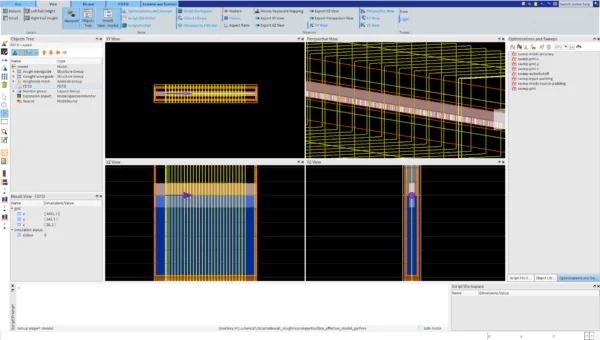
Figure 1: the Lumerical workspace, where Sparrow Quantum builds and analyses nanophotonic structures. Here, a waveguide is modelled, and the electromagnetic field is monitored at multiple locations to identify and quantify scattering losses along the device.
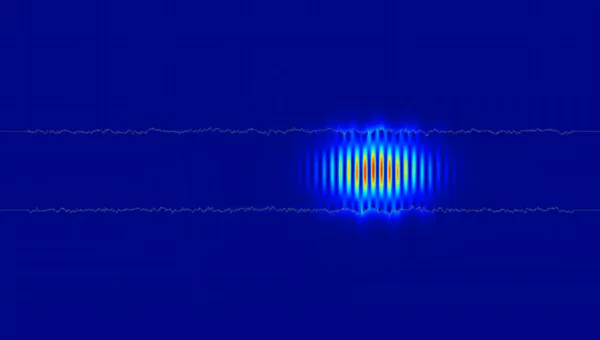
Figure 2: Simulation results of light propagating in a waveguide with fabrication-induced defects. The white boundaries represent non-ideal sidewall that model realistic defects. The contour plot shows the electric field distribution, highlighting how scattering impacts the propagation in the lossy photonic structure.
By integrating Ansys Lumerical, Sparrow Quantum has been able to reduce reliance on costly fabrication cycles and focus on the most promising design approaches earlier in the process. Exploring options in parallel rather than sequentially means fewer physical iterations, shorter development cycles, and greater confidence in each fabrication step.
For this kind of nanophotonic design work, simulation isn’t optional – there’s simply no realistic experimental alternative. Within the simulation space, the clearest point of comparison is open-source FDTD tools:
There are open-source FDTD solutions out there, and compared to those, Lumerical is roughly 2–10 times faster. It’s also significantly easier to work with and offers a strong library of example files for different types of components.
That ease of use also makes Lumerical accessible across a broad range of roles – from photonics engineers and researchers to R&D teams and students.
Lumerical is a powerful tool that makes it possible to quickly evaluate different designs and arrive at optimized structures. It gives you insight into how the components behave that simply isn’t possible without simulation.
As Sparrow Quantum continues to grow, simulation is expected to play an increasingly central role in its development process. By enabling deeper insight into chip performance, simulation supports continued improvements in efficiency and design precision, as well as the final stages of optimization.
As Oscar explains:
I think it will just become more and more important as we grow… We need to use simulation to really get those last percent of efficiency.
As quantum technologies move closer to real-world applications, scalability becomes a critical challenge. Simulation helps bridge design and manufacturability, supporting the development of reliable quantum hardware and accelerating innovation in areas such as quantum computing and communication. In this context, simulation is not just a supporting tool, but a key enabler of continued performance improvements.
Ansys Lumerical does not only offer support for waveguide design, but for a broad span of applications such as LEDs, metalenses, photonic integrated circuits and components. It offers also workflows in conjunction with other ray optics design tools in Ansys family such as Zemax OpticsStudio and SPEOS for applications such as AR/VR and coatings.