Redefining High‑Performance Particle Simulation with Ansys Rocky
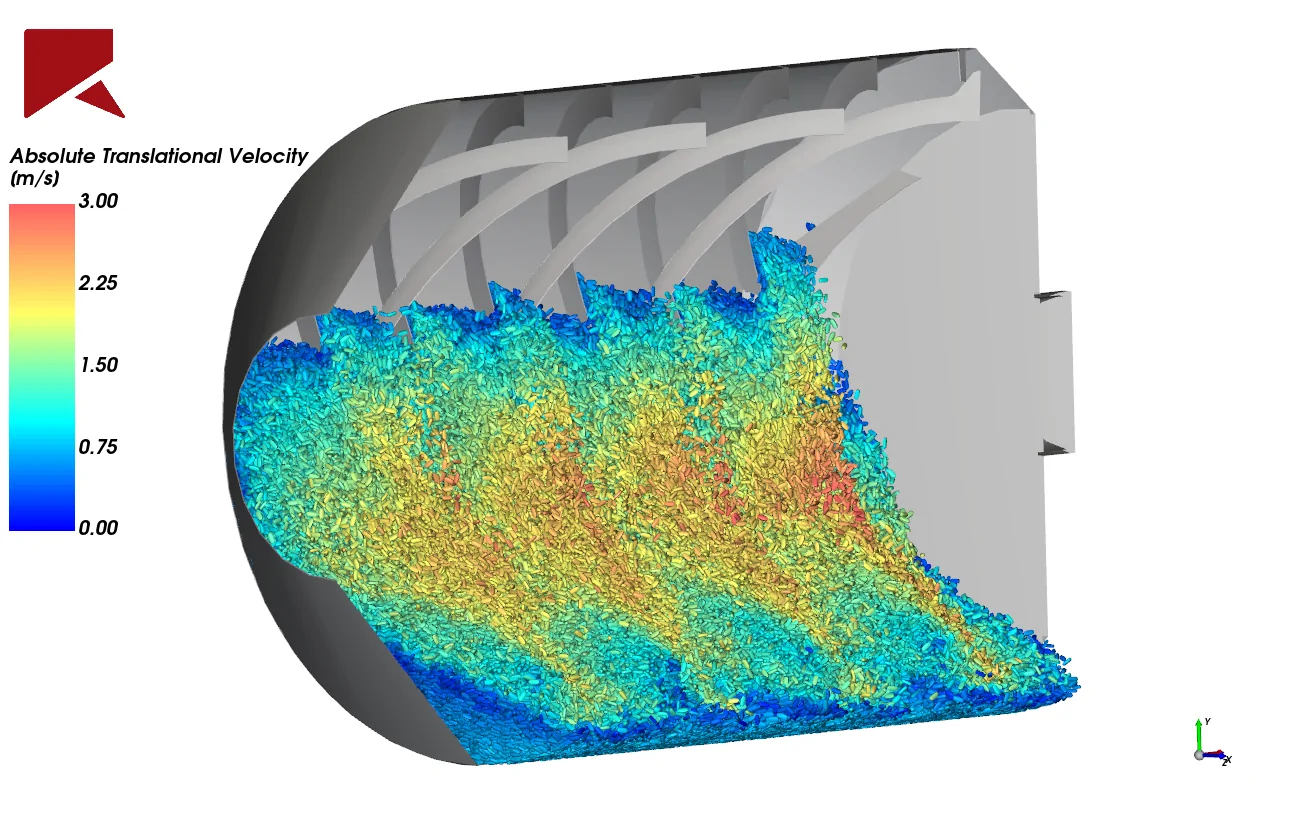

At the heart of simulation technology lies the ability to replicate real‑world physical behavior in virtual environments. Ansys Rocky is a powerful Discrete Element Method (DEM) simulation tool that enables engineers to model, analyze, and optimize the behavior of granular materials in exceptional detail.
Simulation provides insight that physical testing alone cannot. Experimental testing is expensive, time‑consuming, and limited in scope. By contrast, a virtual test lab allows organizations to experiment freely, iterate faster, and bring products to market with greater confidence. This not only reduces cost and time—it drives innovation by giving engineering teams the freedom to explore new ideas safely and efficiently.
Ansys Rocky began as a specialized DEM tool focused on particle behavior in the mining industry. Over time, it evolved into a comprehensive granular material simulation platform, now fully integrated into the Ansys multiphysics ecosystem.
Today, Rocky supports everything from simple spherical particles to highly complex shapes and flexible bodies such as fibers and shells. At its core, Rocky models granular materials—systems containing thousands or even millions of particles—and analyzes how they move, interact, break, and wear over time.
Granular materials appear across nearly every industry:
By simulating these processes accurately, Rocky helps engineers address challenges such as clogging, buildup, uneven mixing, and excessive equipment wear—issues that can lead to downtime, high maintenance costs, and equipment failure if left unresolved.
One of Ansys Rocky’s standout capabilities is its ability to represent real‑world particle shapes. Unlike traditional DEM tools that rely on basic spheres or ellipsoids, Rocky supports highly detailed particle geometries.
Users can:
Whether simulating jagged rocks, potato chips, or flexible polymer fibers, Rocky captures complex particle‑to‑particle interactions with high fidelity. This level of realism is critical for predicting bulk material behavior accurately.
For cohesive or wet materials, Rocky includes models for liquid bridges and moisture‑driven clumping. These features are especially valuable in applications such as tablet coating, wet powders, or food processing, where stickiness directly affects flow and product consistency.
Ansys Rocky was among the first DEM tools to fully exploit GPU acceleration. Because particle simulations involve millions of parallel interactions, Rocky performs exceptionally well on GPU hardware.
The result is dramatic performance improvement:
Whether modeling a high‑speed conveyor, a coating drum, or a crushing operation, Rocky delivers the speed required for real‑world engineering timelines.
Rocky is widely used to simulate cone crushers and milling systems. Engineers can analyze particle breakage, impact forces, and wear patterns to improve throughput, reduce liner wear, and extend equipment life.
In food manufacturing, Rocky has been used to simulate processes such as seasoning potato chips. By modeling drum motion, particle interactions, and seasoning flow, manufacturers can achieve uniform coating while minimizing product damage.
Rocky excels in pharmaceutical mixing and coating simulations, where consistency is critical. Engineers can visualize mixing patterns, analyze coating thickness, and assess how moisture or particle size impacts final product quality.
Rocky includes advanced wear models that allow users to simulate long‑term equipment degradation. Time acceleration techniques make it possible to observe wear progression over weeks or months within a single simulation.
A major strength of Ansys Rocky is its seamless integration with Ansys Mechanical and Ansys Fluent.
Rocky supports one‑way and two‑way coupling with structural analysis. Engineers can simulate particle loads on structures such as crusher mantles or conveyor frames, then feed resulting deformations back into the DEM model to capture feedback effects.
When coupled with Fluent, Rocky enables detailed particle–fluid interaction simulations. Applications include cyclones, pneumatic conveying, and separators. One‑way coupling models fluid influence on particles, while two‑way coupling allows full interaction between phases.
For faster analysis in less complex systems, Rocky also offers a porous media approach for efficient fluid‑particle modeling.
One of the most exciting recent developments in Ansys Rocky is the integration of Smooth Particle Hydrodynamics (SPH). This meshless CFD method models fluids as particles, allowing fluid and solid simulations to run entirely within Rocky—without requiring Fluent.
SPH enables new use cases such as:
This opens the door to fully coupled, highly efficient multiphase simulations in a single environment.
Accurate DEM simulation depends on reliable material properties. Ansys Rocky supports this through:
A common validation example is the angle of repose test, where simulated particle piles are compared to experimental results. By matching simulation output to physical benchmarks, users can calibrate input parameters and ensure realistic behavior.
From mining and manufacturing to food processing and pharmaceuticals, Ansys Rocky enables engineers to simulate granular materials with unmatched realism. Its ability to model particle motion, breakage, wear, heat transfer, and fluid interaction makes it one of the most versatile DEM tools available.
As simulation becomes increasingly central to product development, Rocky helps engineers predict performance, reduce risk, and optimize designs before building physical prototypes.
If you’re interested in how Ansys Rocky can support your specific workflow—or want to explore DEM simulation in more detail—get in touch with our team.
Learn more