Short-Circuit Force Simulation for Safer Substation Design
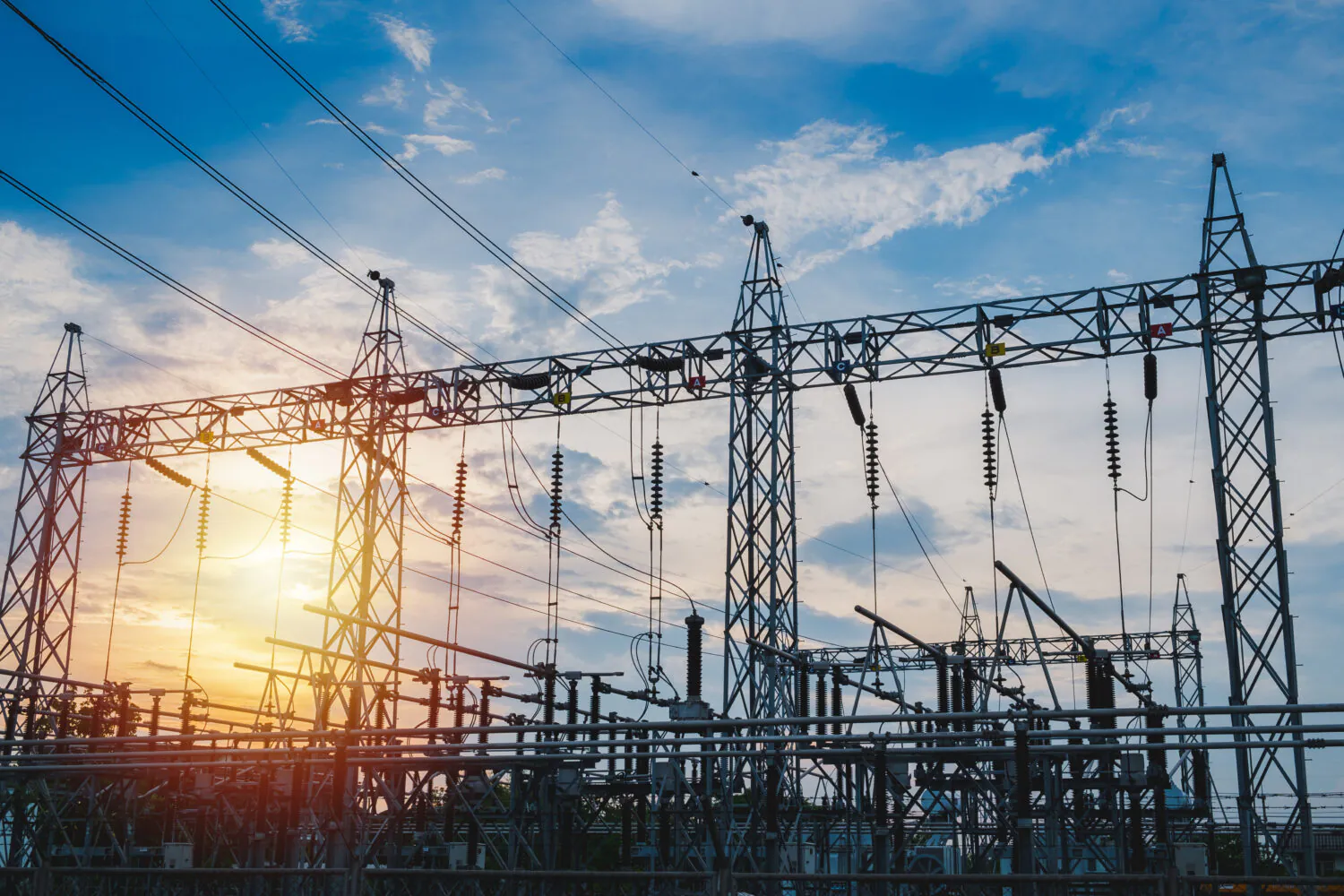

Short‑circuit events place extreme mechanical demands on electrical conductors and their supporting structures. In substations and transmission systems, fault currents generate intense electromagnetic forces that can cause large displacements, high axial stresses and dynamic conductor interaction. Accurately predicting this behaviour is essential for maintaining electrical clearances, preventing structural damage and ensuring long‑term system reliability.
When large currents flow through neighbouring conductors, the magnetic fields they generate interact, producing forces that depend on current magnitude, geometry and spacing. These forces act over very short time scales and can result in conductor attraction, repulsion or sustained contact during the fault. Once the current clears, conductors may continue to vibrate under gravity loading.
Traditional electromagnetic solvers can model these effects, but they often become impractical when applied to large, flexible conductor systems requiring transient structural coupling. As a result, engineers have historically relied on simplified force estimates or decoupled workflows.
To overcome these limitations, LS‑DYNA’s Resistive Heating solver has been extended to support electromagnetic interaction between conductors that are not in mechanical contact. This development enables conductors to be modelled using beam elements while still capturing the physical electromagnetic forces between them.
The magnetic field generated by current‑carrying conductors is calculated using the Biot–Savart law, and electromagnetic forces are determined using the Lorentz force formulation. These forces are applied directly to the structural model at each time step, allowing conductor motion and electromagnetic loading to evolve together throughout the simulation.
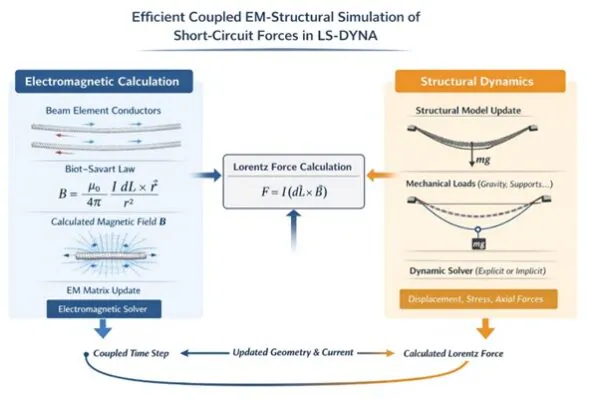
Using beam elements offers a significant computational advantage compared to full 3D electromagnetic models. Long, slender conductors can be represented accurately with far fewer degrees of freedom, making it feasible to simulate realistic substation and transmission‑line configurations.
The coupled workflow supports both explicit and implicit structural solvers and includes gravity loading, electrical boundary conditions and time‑dependent current profiles. This enables engineers to model the complete fault sequence, from current initiation through conductor interaction and post‑fault vibration.
The enhanced solver has been validated against established numerical benchmarks and verified using experimental data from historic substation tests documented by CIGRE. Simulations show good agreement with reference results, capturing key response characteristics such as mid‑span displacement, axial force evolution and minimum clearance distances.
Example studies demonstrate the solver’s ability to reproduce pinch effects, conductor sticking, spacer‑constrained behaviour and transient vibration, providing engineers with a realistic picture of system response under extreme loading.
With this extended capability, engineers can now:
All of this can be achieved within a single LS‑DYNA workflow, improving both efficiency and confidence in design decisions.
EDRMedeso helps power‑system engineers apply advanced LS‑DYNA capabilities through simulation consulting, process development and specialist training. Whether validating existing designs or exploring new concepts, our experts support the effective use of electromagnetic–structural coupling for real‑world engineering challenges.