Agentic Simulation Maturity Roadmap

Agentic simulation is not an AI model attached directly to a solver. It is a governed engineering system in which AI coordinates approved methods, deterministic tools, trusted data and human decision rights. Yet many organizations are approaching the opportunity from the wrong direction. The question is not how to add AI to existing simulation processes. The question is how to create an engineering system that allows AI to participate safely, predictably and accountably in engineering decisions. Authority remains with validated physics, controlled workflows and accountable experts.
Engineering organizations cannot implement agentic simulation by starting with an autonomous agent. It is achieved by first making expert methods explicit, repeatable, testable and accessible as controlled services.
The future architecture therefore has two equally important halves. The first is the execution capability: solvers, meshing, automation, optimization, surrogates, data movement and compute. The second is the trust backbone: approved methods, configuration control, provenance, permissions, validation gates, audit and human sign-off.
The simplest mental model is that the language model is the coordinator, not the engineering authority. It interprets intent, builds a plan and calls tools. Those tools carry out known engineering actions. Solvers verify physical behavior. Governance determines what may proceed automatically and what must be escalated.
This paper describes a practical maturity model for agentic simulation, the technology architecture required to support it and the governance framework necessary to maintain engineering confidence as AI becomes increasingly embedded in simulation-led decision making.
Simulation has undergone several major transformations over the past three decades.
Initially, simulation capability was concentrated in specialist teams, relying heavily on expert knowledge, manual workflows and individual experience. As organizations matured, automation reduced repetitive effort and improved consistency. More recently, optimization technologies, cloud computing and advanced analytics have expanded the reach and impact of simulation across the enterprise.
Agentic simulation represents the next step in this progression.
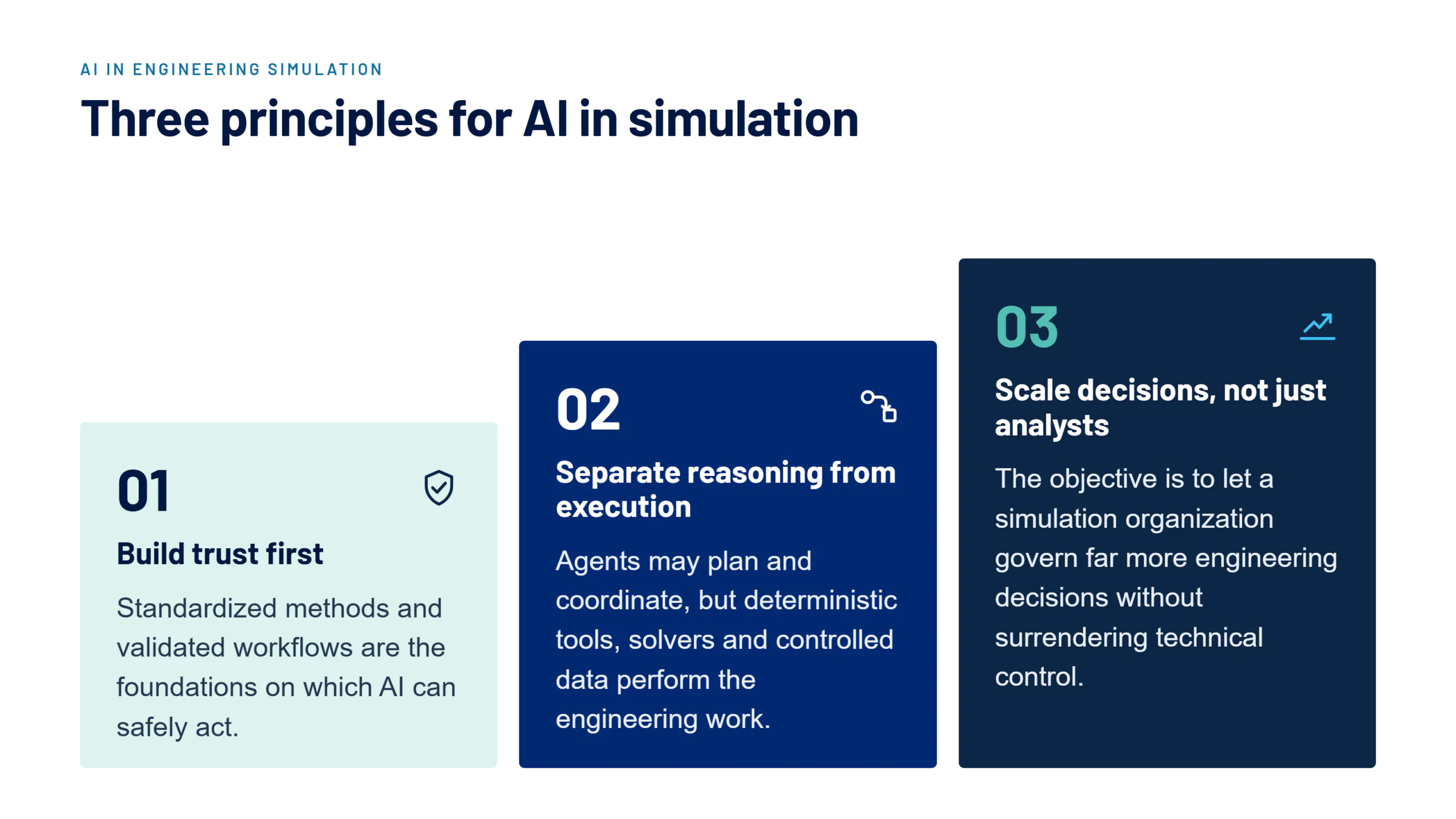
However, unlike previous technology shifts, the value of agentic simulation is not determined primarily by the sophistication of the AI model. Its value depends on how effectively organisations connect AI reasoning with trusted engineering methods, validated workflows and robust governance mechanisms.
Agentic systems can significantly increase the accessibility, speed and scale of engineering decision support. Yet those benefits are only achievable when built upon a foundation of repeatability, traceability and trust.
Simply adding an AI model on top of simulation software does not create an engineering capability. It creates risk.
The maturity path towards agentic simulation is cumulative. Each stage adds capability, building on the strengths of the previous one and introduces new capabilities only after the necessary controls are established. But it also depends on the controls created earlier. None can be omitted; moving to agentic execution without stable methods, workflow validation and traceability may accelerate experimentation and increase system flexibility but often undermines engineering confidence, repeatability and accountability.
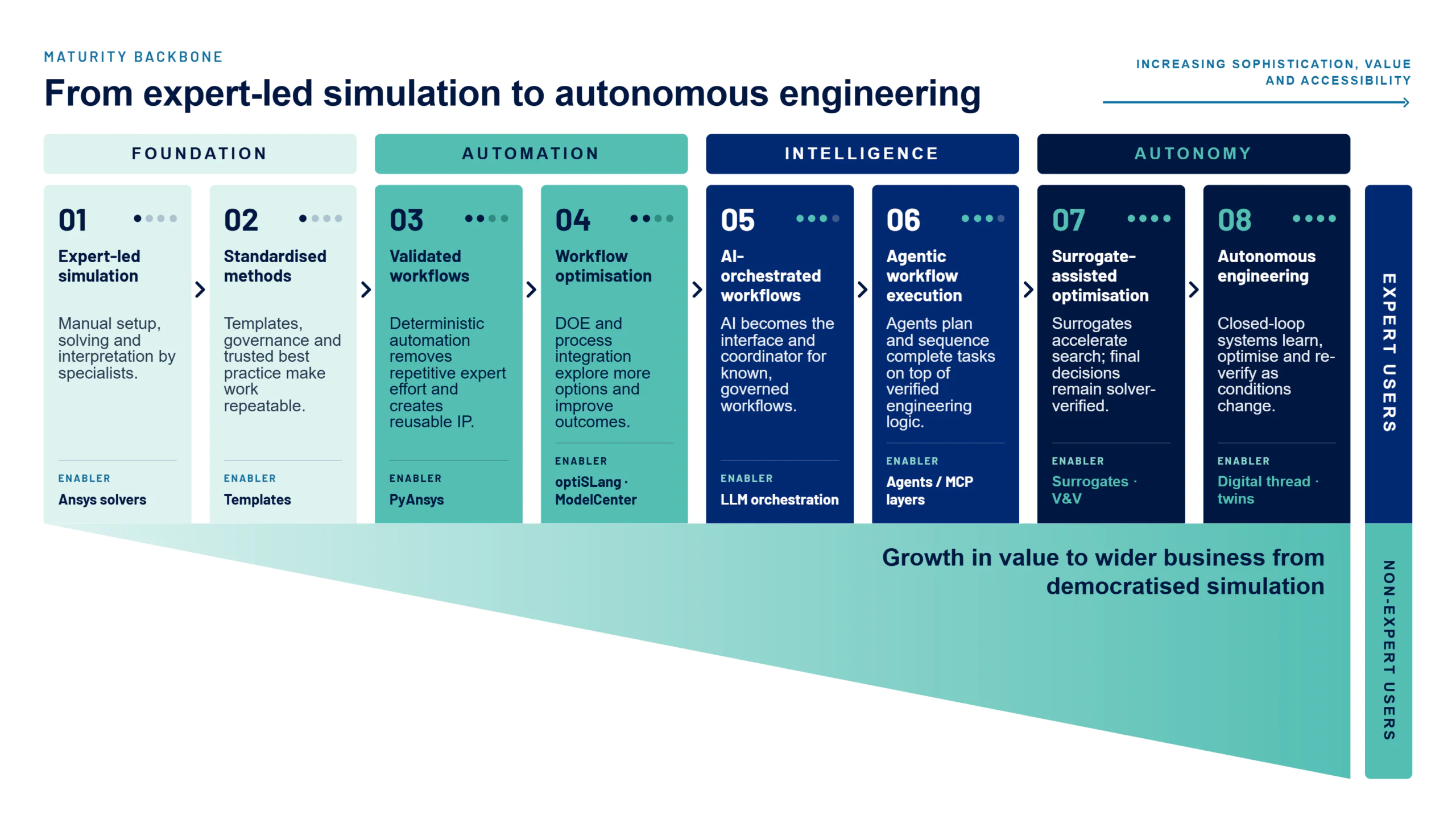
Specialists define modeling assumptions, meshing rules, materials, loads, solver controls, quality checks and reporting standards. The important change is not automation yet. It is agreement on what a trusted method looks like. Much of this knowledge exists as tacit experience rather than reusable intellectual property.
Once trusted methods have been established, automation can be introduced safely. Scripts and workflow platforms connect inputs, setup, solving, checking and reporting into repeatable processes. These workflows encode engineering intent and become reusable intellectual property. The objective is not merely productivity.
The third stage introduces AI-assisted engineering. Natural-language copilots, retrieval and orchestration help users identify and configure approved workflows. Surrogate models can accelerate exploration, while high-fidelity solvers remain responsible for delivering deterministic results for design verification.
The highest level of maturity introduces agentic execution. Agents can plan, select tools, monitor progress, respond to known failures and request intervention. Closed-loop optimization becomes credible only when every action is constrained, observable and traceable. The result is not autonomous engineering. It is controlled delegation.
Agentic simulation should not be viewed as a single technology platform.
Instead, it is best understood as an ecosystem of interconnected capabilities, each fulfilling a distinct role within a larger engineering framework
The value comes from how they are connected and governed.
Authoritative engineering systems
Standard methods and templates
Deterministic workflow automation
Process integration and optimization
Simulation and knowledge management
Surrogate and reduced-order models
Copilots and retrieval
Agentic orchestration
Governed tool-service layer
Compute and data fabric
Trust, policy and observability
A future agentic solution should be layered so that reasoning, engineering execution and governance can evolve independently. The agent should never need direct, uncontrolled access to core engineering systems.
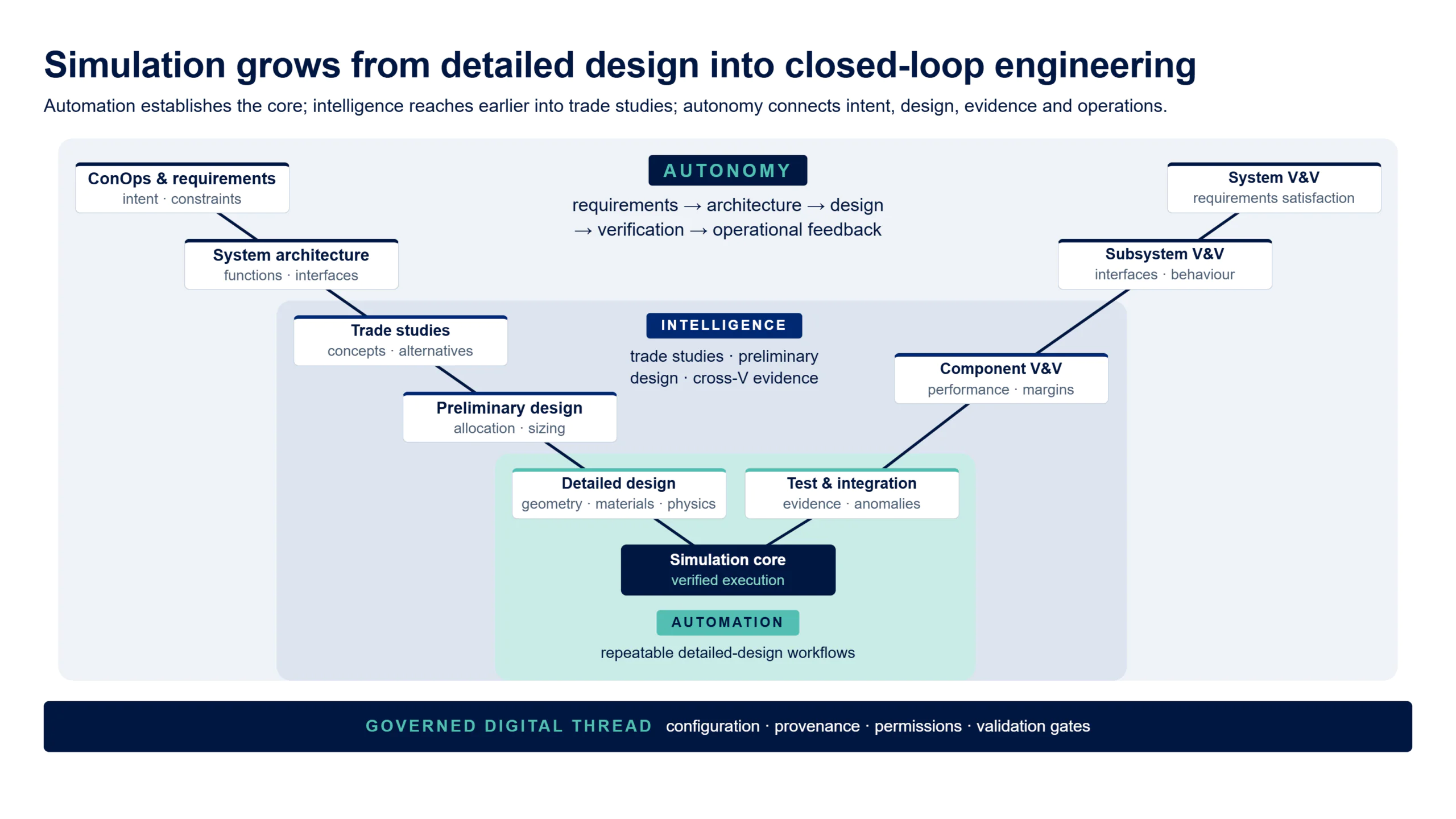
1. Define: Requirements and systems models establish objectives, constraints and verification criteria.
2. Contextualize: The system retrieves the correct product configuration, approved method, prior evidence and permissions.
3. Plan: The orchestration agent decomposes the objective into approved engineering tasks and identifies decision gates.
4. Execute: Tool services invoke geometry preparation, meshing, solver, optimization, data-processing and reporting workflows.
5. Predict: Where appropriate, surrogate models screen options rapidly inside their validated domain.
6. Verify: High-fidelity solvers and automated quality checks test the candidate against requirements and acceptance criteria.
7. Govern: Policy services capture provenance, enforce limits, request human approval and reject out-of-policy actions.
8. Learn and reuse: Accepted evidence, workflow performance and exceptions are curated as governed knowledge for future work.
Carries out the physical analysis: prepare the model and inputs; mesh, solve and post-process; apply deterministic checks; package results and evidence.
Coordinates work but does not replace the physics: interpret the objective; select approved capabilities; evaluate progress and exceptions; continue, retry, re-plan or escalate.
Explores alternatives efficiently: generate candidates; use surrogates for rapid screening; run high-fidelity checks on selected candidates; update the search within controlled bounds.
Maintains engineering accountability: confirm authority and permissions; check method, data and applicability limits; record traceability and cost; apply human approval and final sign-off.
The loops operate at different speeds. Agent reasoning may make frequent coordination decisions, execution may take minutes or hours, optimization may run many parallel studies, and governance may pause the process at defined approval points. Keeping the loops separate improves observability and makes failures easier to diagnose.
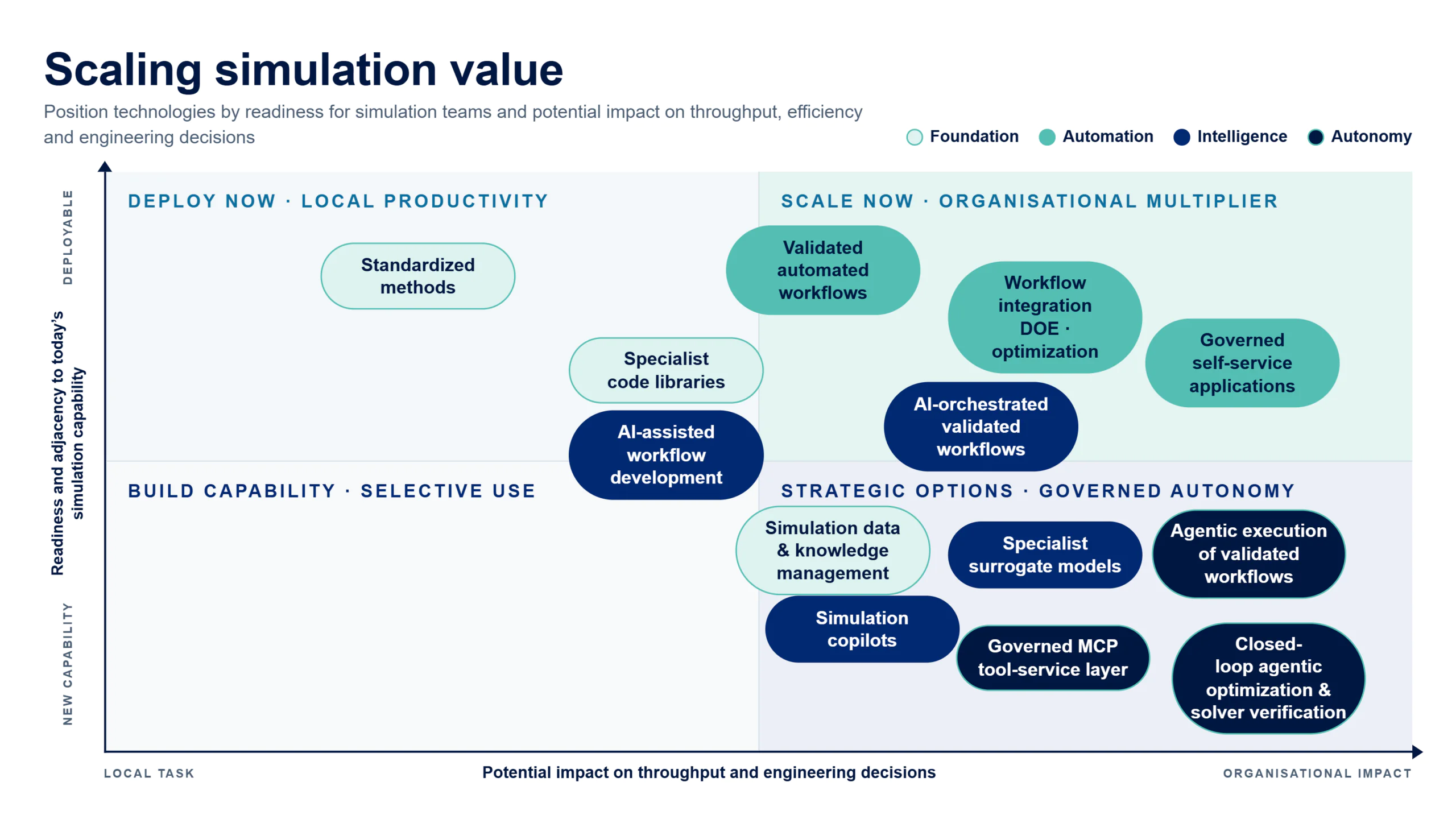
This matrix is a prioritization aid, not a universal roadmap. The strongest near-term opportunities are high-value capabilities adjacent to current simulation practice. Strategic agentic capabilities become credible only after the organization has strengthened data, architecture, validation and governance.
Deploy now: local productivity
Standardized methods, validated automation, workflow integration and AI-assisted specialist code development improve familiar tasks with limited organizational change.
Scale now: organizational multiplier
Governed self-service applications and reusable workflows move routine execution beyond the simulation team while specialists retain ownership of physics and limits.
Build capability: selective intelligence
Surrogates, copilots and AI orchestration require stronger information practices and careful selection of use cases.
Strategic options: governed autonomy
Tool-service layers, agentic execution and closed-loop optimization can transform engineering decisions, but only when the trust backbone is designed as part of the system rather than added later.
In conventional software, governance is often treated as documentation around the system. In agentic engineering, governance must be executable. It must actively determine what the system is allowed to do, with which data and tools, within which limits, and under whose authority.
One of the most common misconceptions surrounding agentic systems is that human involvement gradually disappears as autonomy increases.
The opposite is true.
Human defines the method: Experts determine assumptions, limits, checks and acceptable evidence.
Human supervises exceptions: The system escalates unfamiliar failures, ambiguity or out-of-policy actions.
Human approves consequential decisions: Formal sign-off remains at defined technical or business gates.
Human improves the system: Experts review patterns in failures and update methods, tools, policies and training data.
The logical architecture below can be implemented with different products and deployment models. The important design principle is the separation of responsibility.
Experience layer
Cognitive control
Governed tool services
Engineering execution
Authoritative systems
Data and compute fabric
Trust backbone
The boundary between cognitive control and governed tool services is critical. The agent can decide that a mesh-quality check is required, but it should invoke an approved check with a defined input/output contract. It should not silently invent a new quality rule or bypass the established verification logic.
1. Digitize and standardize
2. Automate and integrate
3. Package and distribute
4. Add intelligence
5. Delegate with control
6. Close the loop
Plausible but incorrect reasoning – constrain the agent to approved tools and methods; require evidence-linked outputs and solver verification
Use outside validated limits – encode applicability ranges, uncertainty thresholds and escalation rules
Loss of configuration context – bind every run to a controlled requirement set, product configuration, workflow version and data package
Untraceable decisions – capture plans, tool calls, inputs, outputs, checks, approvals and exceptions as a complete result package
Automation of a poor method – validate the engineering method before automating it; automation scales defects as effectively as good practice
Overdependence on one model or vendor – use modular service boundaries so reasoning models, solvers and infrastructure can be changed without redesigning the whole system
Security and IP exposure – apply least privilege access, deployment choices appropriate to data sensitivity, and controls around prompts, models, workflows and results
Uncontrolled cost or compute use – set budgets, concurrency limits, stop conditions and approval gates for expensive studies.
The architecture changes the division of labor rather than removing engineering accountability
The long-term opportunity presented by agentic simulation is not simply more automation.
It is the ability to scale engineering decision-making.
Today, simulation specialists perform many analyses directly. In the future, specialists increasingly become custodians of engineering methods, validation frameworks and organisational knowledge.
Their expertise enables a far wider community of engineers to access trusted simulation capability while maintaining technical integrity
This represents a fundamental shift in how engineering organisations create value.
Simulation evolves from a specialist service to an organizational capability.
Agentic simulation is best understood as an architecture for controlled delegation. AI supplies flexible coordination and a more accessible interface, but trusted engineering remains rooted in approved methods, deterministic execution, controlled data, solver verification and accountable people.
The near-term priority is therefore not maximum autonomy. It is the creation of reusable engineering assets: standard methods, validated workflows, specialist libraries, governed data and tool services. These assets deliver value immediately and form the dependable foundation for future agents.
The long-term opportunity is substantial. When requirements, workflows, surrogates, solvers and evidence are connected through a governed digital thread, simulation can influence decisions earlier, support more users and participate continuously across design, verification and operation.
The destination is not uncontrolled, autonomous engineering. The destination is closed-loop, human-governed engineering at scale, where expertise, simulation and AI combine to accelerate innovation while preserving confidence, accountability and trust.